73 Seconds
Written and Performed by Jared Mezzocchi. Directed and Co-Developed by Aya Ogawa (they/them).
Lower Eastside Girls Club Planetarium | 402 E 8th St, New York, NY
May 18, 2026.

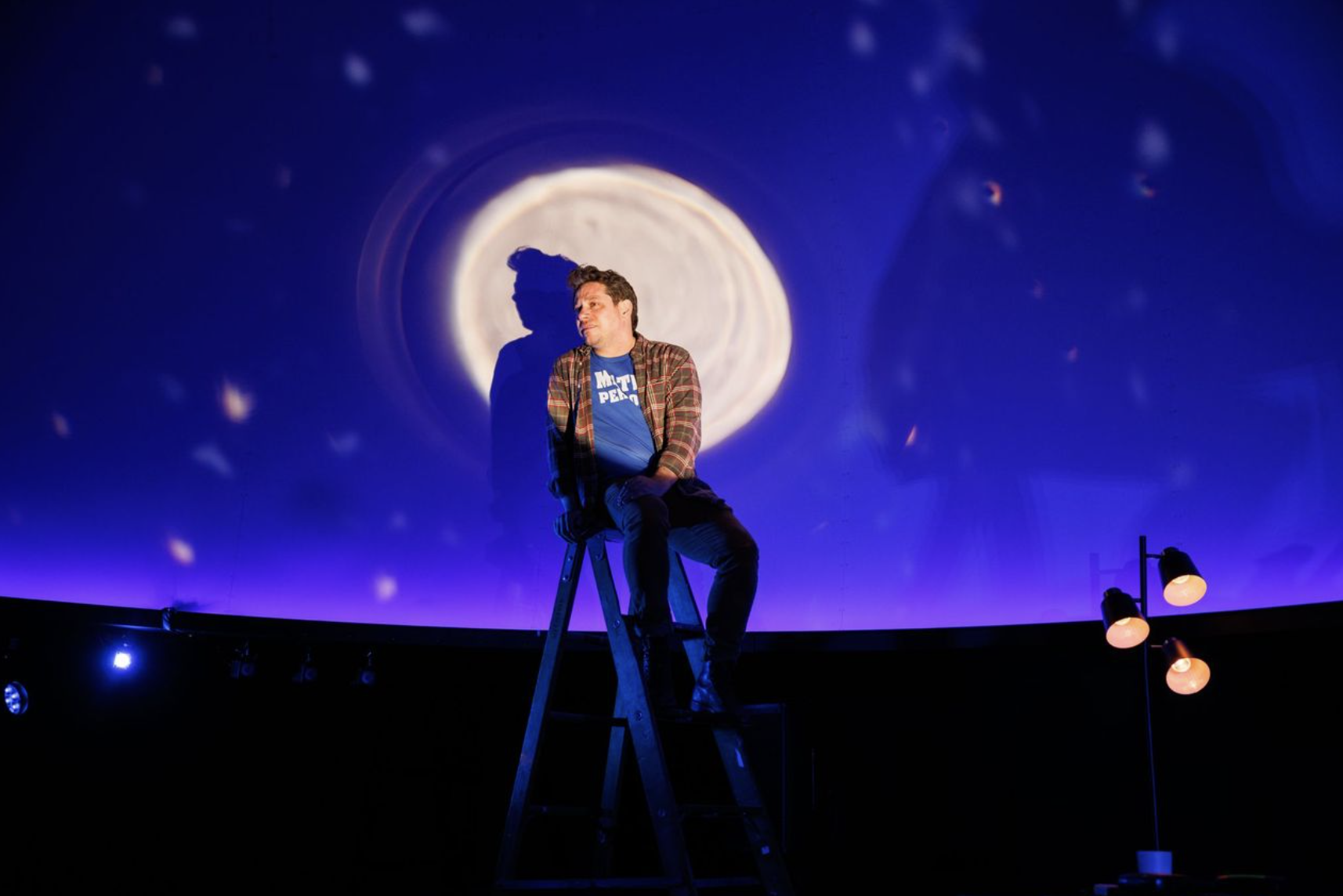
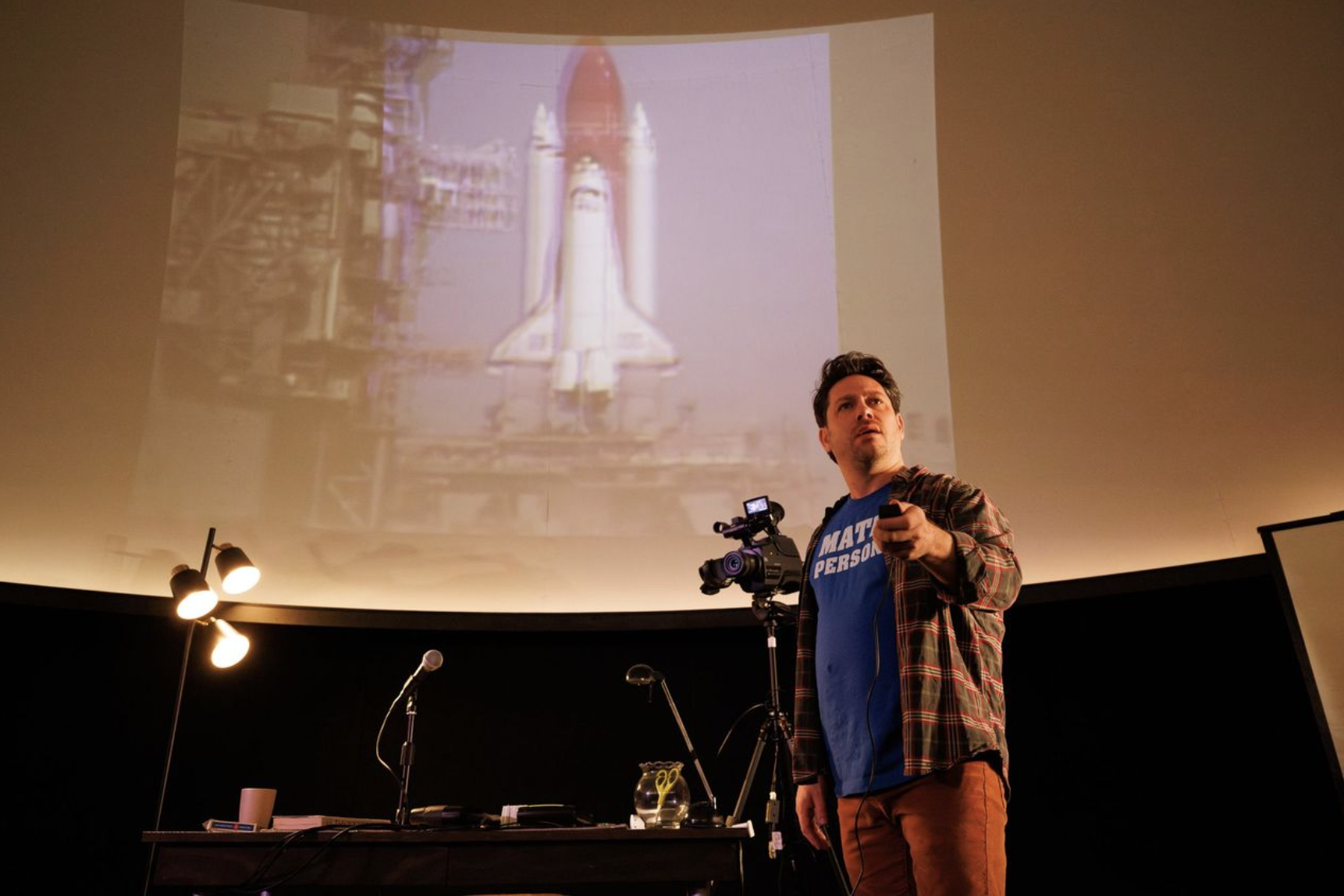
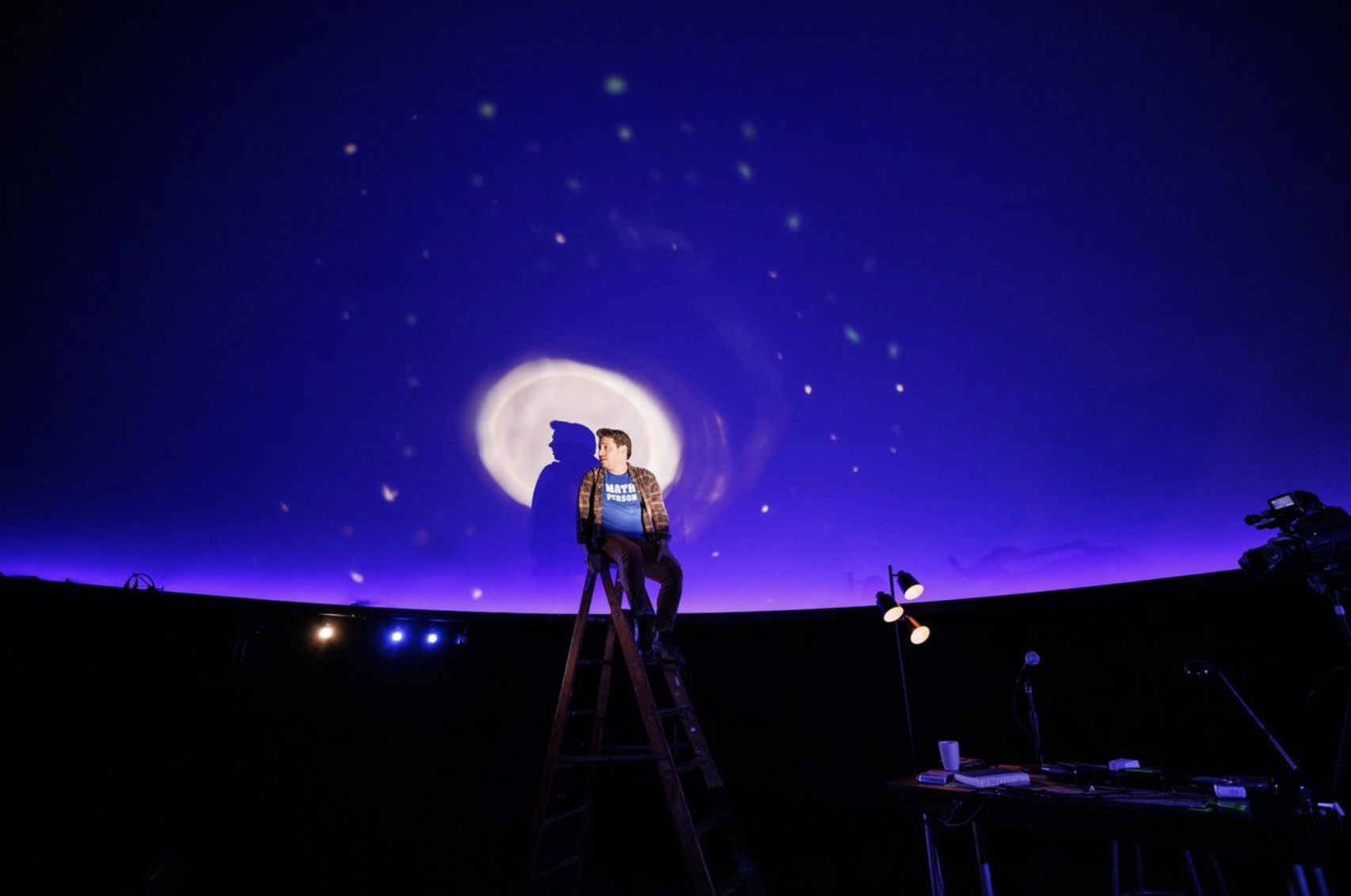
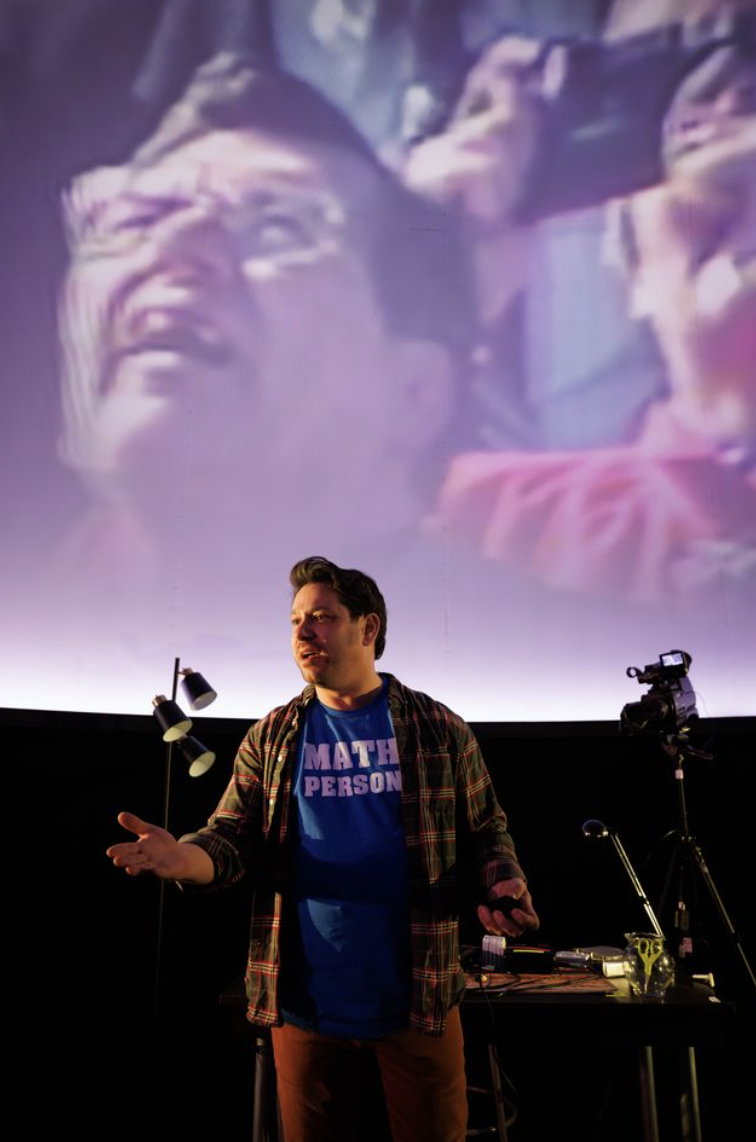
The solo show has a problem it rarely names: the performer is always the author of their own feelings. There’s no outside intelligence shaping what gets revealed and when, no dramatic pressure other than the performer’s appetite for disclosure. The result, in a hundred well-intentioned autobiographical pieces, is the theatrical equivalent of a moving journal, honest, specific, and ultimately closed to you.
73 Seconds is not that. What makes it different has less to do with its distinctive analog technology, overhead projectors, cassette tapes, VHS camcorders deployed under the 64-seat dome of the Lower Eastside Girls Club Planetarium, and everything to do with Aya Ogawa’s direction.
Ogawa (they/them), the Obie Award-winning theater-maker, is officially credited as director and co-developer. The second title is the key. Mezzocchi, a two-time Obie Award winner whose previous En Garde Arts collaboration The Wind and The Rain was staged on a barge in Red Hook, arrived with a massive archive of family stories and a formal obsession with 1980s technology. Ogawa took that material and built from it what they describe in their program note as “a coherent constellation of memories.” The astronomical metaphor is apt. What Ogawa recognized is that memories of a parent have the same structural quality as starlight: you receive them at a remove, through light that left its source long before you existed to register it.
Mezzocchi’s subject is his mother, Rosemary, who worked at NASA and was a contender for the Challenger mission. She died with Alzheimer’s. The title counts those seconds: the 73 that elapsed between the Challenger’s launch and its explosion on January 28, 1986. But the show’s grief runs deeper than any single historical event. There is the woman who once aimed herself at space, and then there is the woman who disappeared into the disease. Two different kinds of unreachable. The show darkens as it moves through those losses. A son documenting a mother with Alzheimer’s cannot give her back her own perspective. That perspective is already gone. The one-sidedness is the condition of the material, not a flaw in the writing.
That condition is where Ogawa works. Mezzocchi is not an actor by trade, but he brings something technique alone cannot buy: warmth, self-deprecating humor, and an unguarded quality that keeps you invested in him even in the show’s most difficult passages. Ogawa has structured the work so that these qualities do exactly what they’re suited for. The gap between who Mezzocchi is as a performer and who his mother is as a subject becomes the drama itself. The analog technology isn’t deployed as nostalgia or visual spectacle. It’s a formal argument that what has passed cannot be reproduced exactly, only re-encountered under different conditions. For a show about Alzheimer’s, that formal argument is also a precise emotional one: you can still see the shape of the person through the distortion, but the signal keeps degrading. Vinny Mraz, credited as Technology Lead, calibrates the analog media that gives this argument its physical form. The lineage runs directly through Samuel Beckett’s Krapp’s Last Tape, where a man sits alone with a tape recorder, playing back his younger voice and discovering that the person who made those recordings no longer exists to claim them. The irrecoverable person is someone else.
This is also a proof of concept for something Mezzocchi has been arguing for years: that technology and design shouldn’t decorate theater, they should build it alongside the performers from the first day of development. 73 Seconds was shaped across residencies at Catskill Art Space, the Colorado New Play Festival, and Ideal Glass Studios. The work shows. Nothing here looks installed.
Tucked inside the Girls Club building on East 8th Street, the Lower Eastside Girls Club Planetarium is the kind of space you don’t know exists until someone brings theater into it and you understand, suddenly, that it was always waiting. Jeanette Oi-Suk Yew’s light and projection design works both registers of the dome: the full-dome starfields that make the curved ceiling feel purposeful rather than borrowed, and the Challenger footage, which arrives with restraint rather than spectacle. Just as compellingly, the moments without any projection at all, where the architecture’s full height becomes the image. Yew’s eye is precise, and she knows exactly when to let the space breathe. Ryan Gamblin’s sound design avoids the trap most solo shows fall into: scoring your feelings for you in advance. Calvin Anderson’s scenography keeps the space intimate without making it small. These aren’t incidental choices. They reflect a director who understood that the audience needed to find the emotion themselves rather than receive it pre-processed.
Ogawa’s program note carries the dimension of this work that the show itself never states outright. They came to this project while processing the death of their own mother, who died fifteen years ago, a grief that also informed their recently premiered Meat Suit, or the shitshow of motherhood at Second Stage. Ogawa knew what it costs to lose a mother. What this collaboration added to that knowledge is the specific wreckage Alzheimer’s puts on top of ordinary grief: the disease makes you lose someone twice, once to itself and once to death, so grief arrives before it is permitted to arrive. 73 Seconds lives in that interval. Ogawa held it without resolving it.
The result is a solo show that functions as a duet between a performer and a director who found together the one thing that separates theater from documentary: the live moment in which someone is changed by the act of remembering in front of you.
Click HERE for tickets.
Review by Ariel Estrada.
Published by Theatre Beyond Broadway on May 18, 2026. All rights reserved.
