
RHEOLOGY
Written and directed by Shayok Misha Chowdhury; In collaboration with Bulbul Chakraborty
The Peter Jay Sharp Theater at Playwrights Horizons | 416 West 42nd Street, New York, NY 10036
April 14 - May 29, 2026
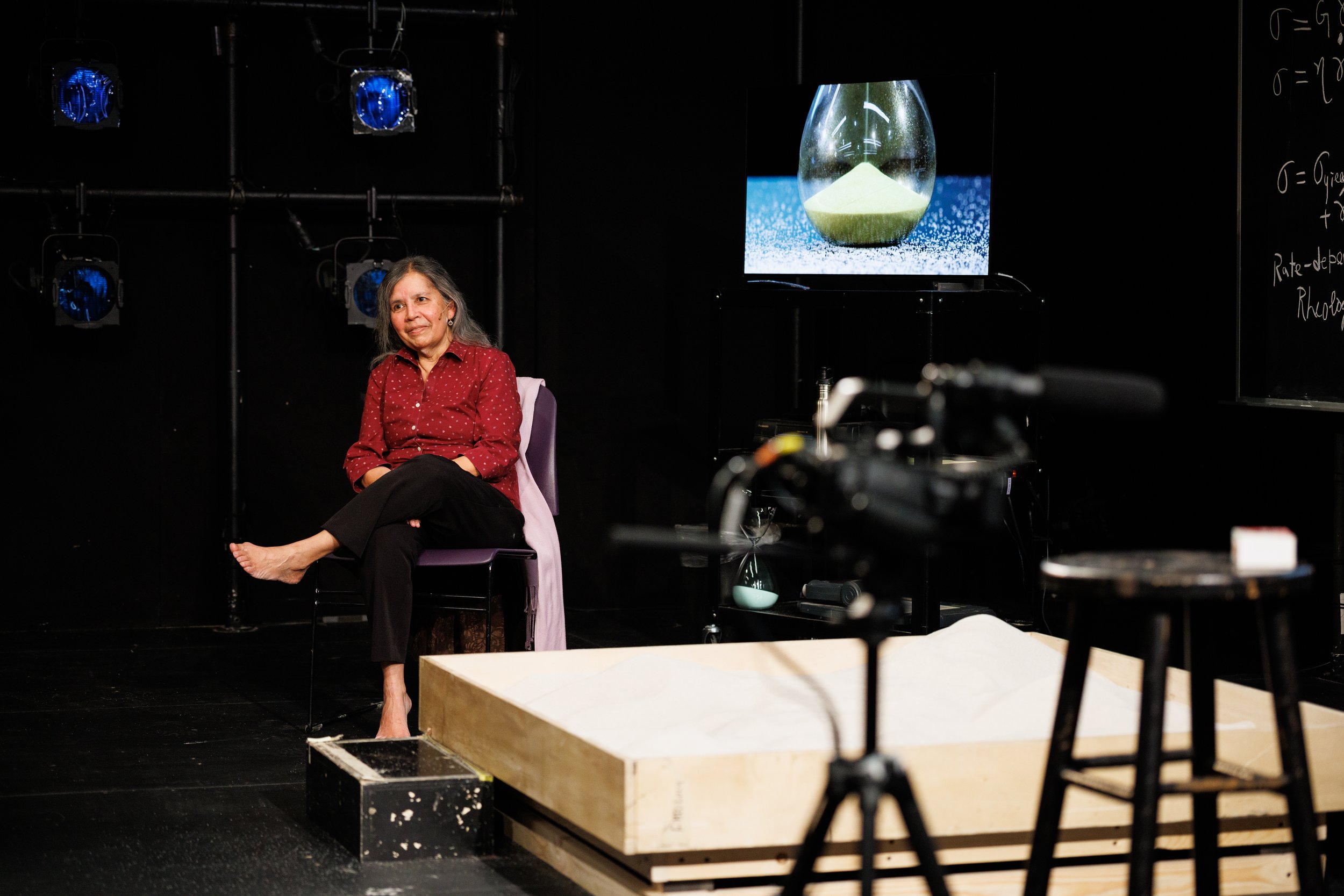
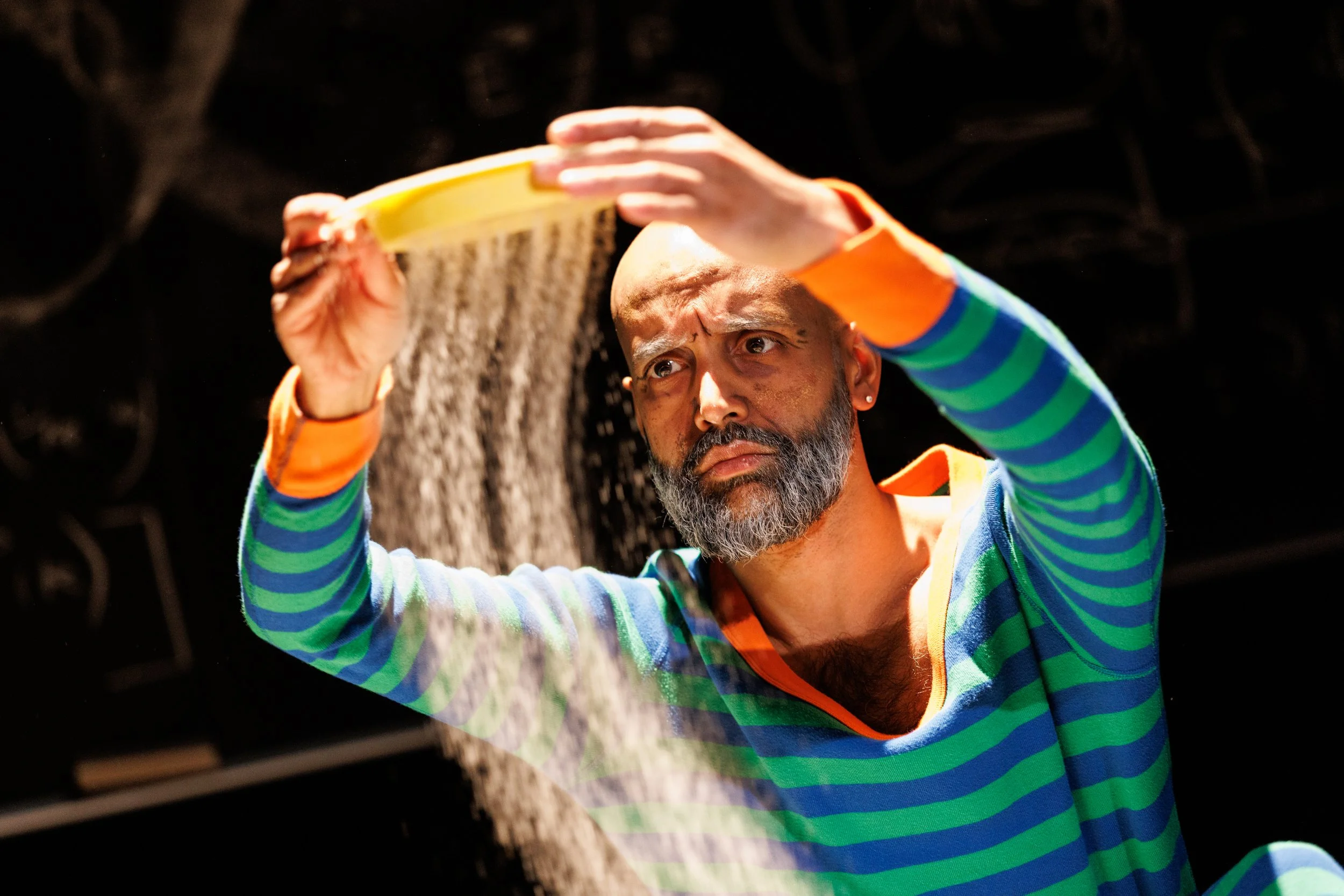
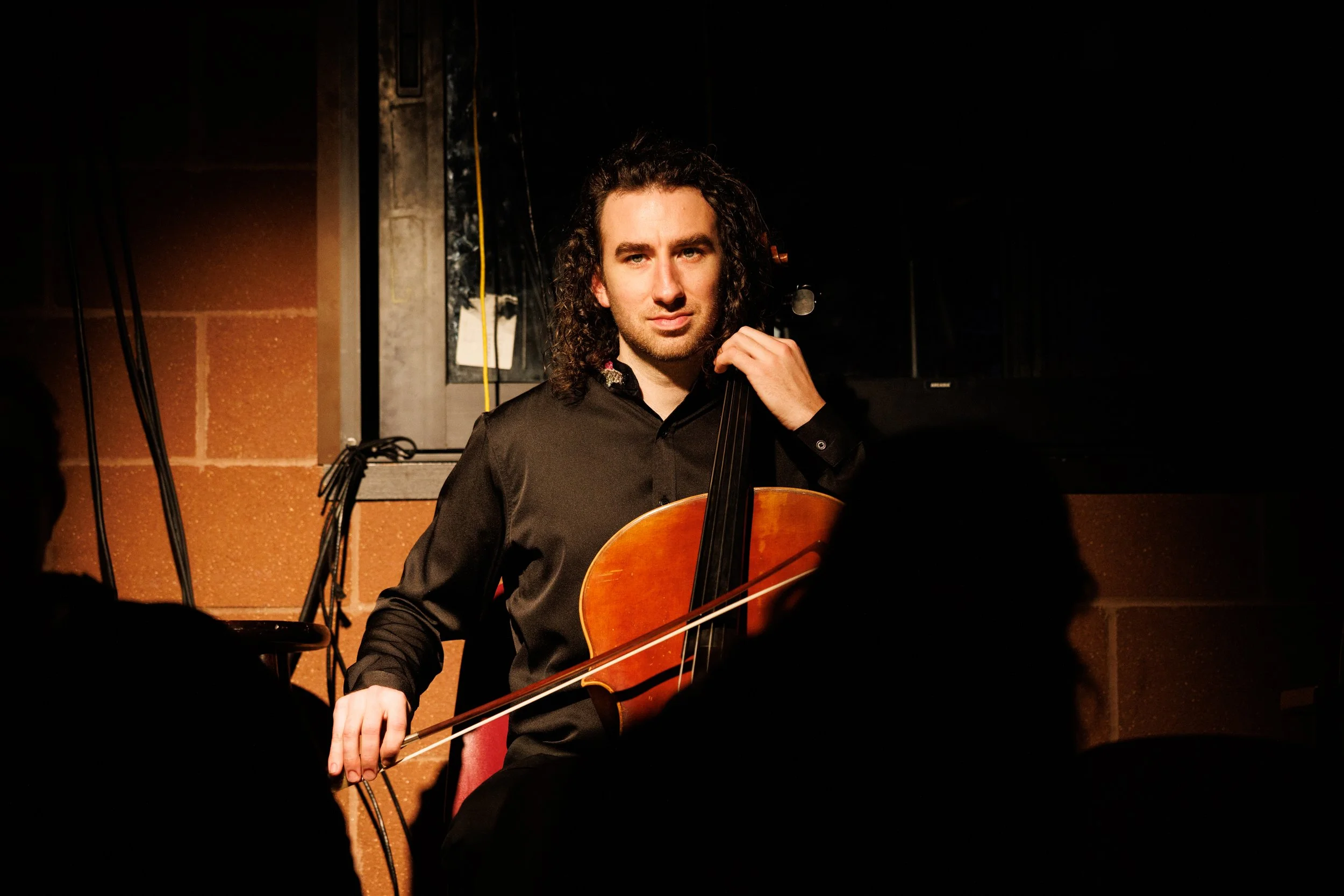
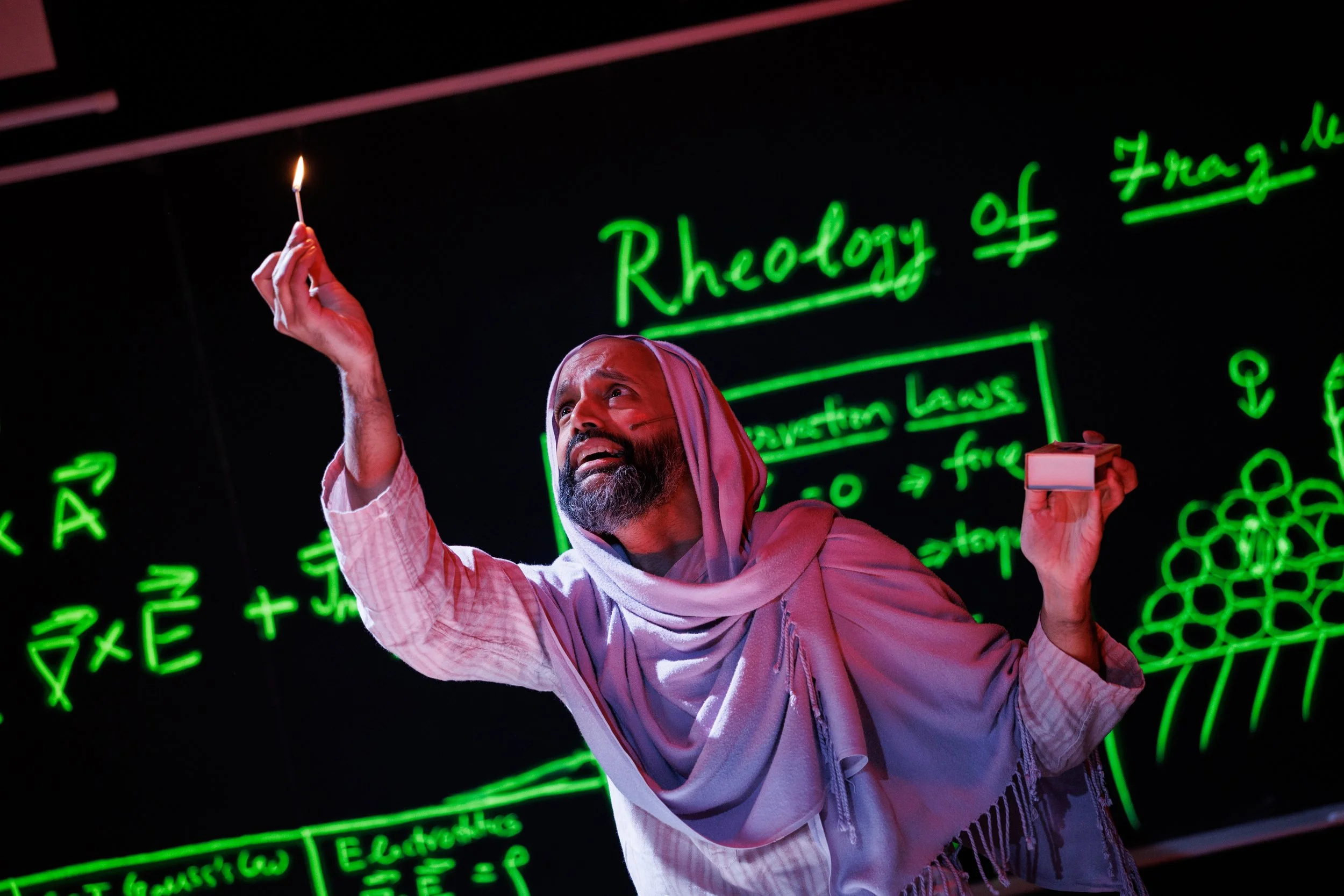
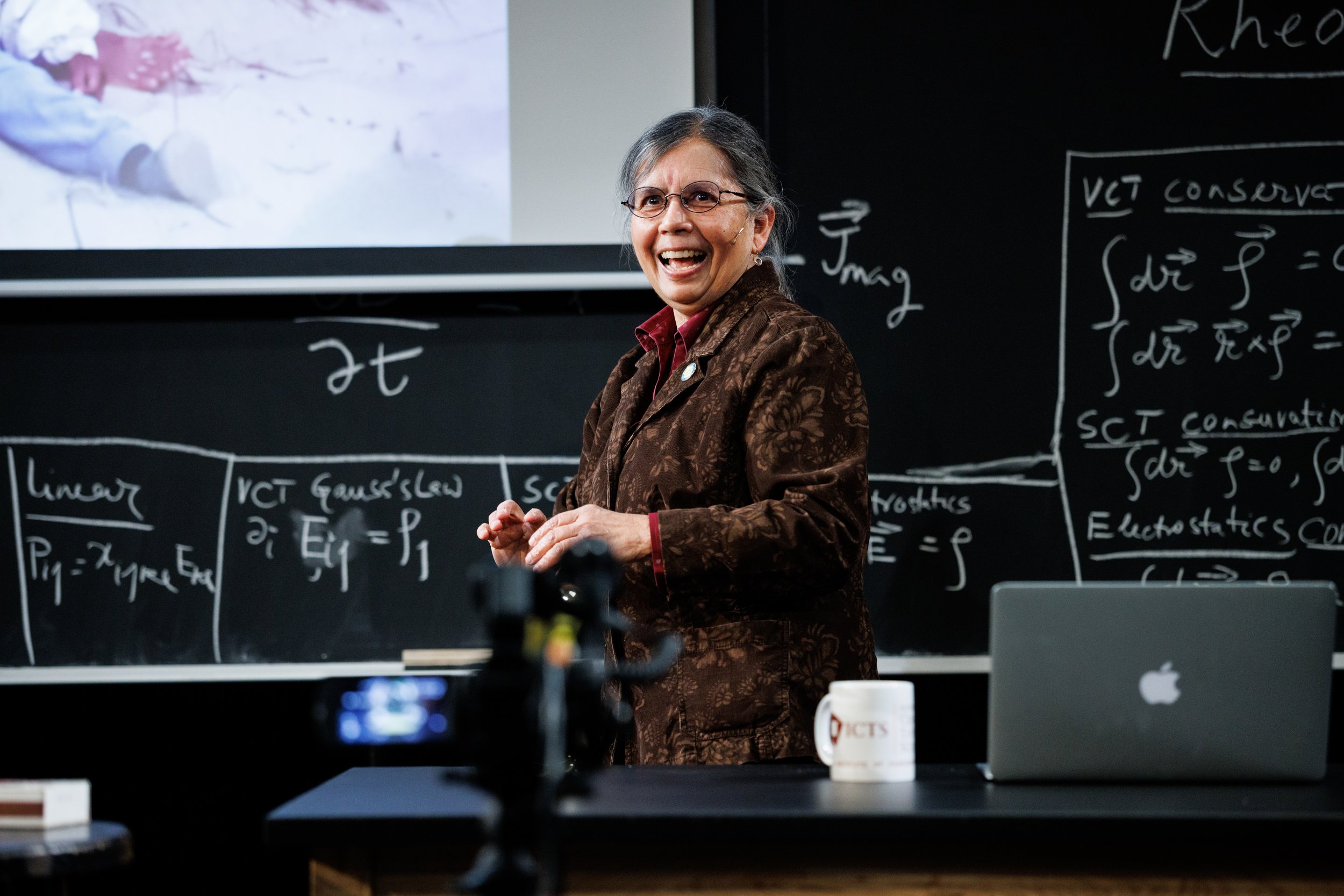
Photo Credit: Maria Baranova
There are plays that dramatize grief, plays that anatomize intellectual life, and plays that seek to collapse the boundary between performance and lived experience. Shayok Misha Chowdhury’s astonishing Rheology, now returned to Off-Broadway at Playwrights Horizons after its celebrated premiere at The Bushwick Starr, attempts all three simultaneously and emerges as something rarer still: a theatrical event of profound intellectual rigor and shattering emotional candor. Part lecture, part memoir, part séance, part scientific inquiry into the nature of endurance itself, the production folds physics, ritual, autobiography, and metaphysics into a work of startling originality. One leaves less with the feeling of having watched a play than of having undergone an experiment in mortality.
The title is not metaphorical decoration but conceptual architecture. Rheology, the branch of physics concerned with the deformation and flow of matter under stress, becomes the governing principle of the evening. Chowdhury’s mother and collaborator, Bulbul Chakraborty—a renowned theoretical physicist with a decades-long fascination with granular substances, especially sand—begins the evening by delivering what appears to be a genuine university lecture. She writes equations across an immense blackboard before the audience enters; she quizzes spectators on the distinctions between solids and liquids; she demonstrates the uncanny instability of sand, whose particles are solid yet collectively behave like fluid matter. An enormous hourglass looms nearby, steadily draining as though time itself were being experimentally measured before our eyes.
What is miraculous is the utter absence of condescension in these opening passages. Chakraborty possesses the rare charisma of a beloved professor whose delight in knowledge becomes contagious. The theater transforms into a classroom, yet the classroom gradually reveals itself as a sanctuary for terror, longing, and love. Her central inquiry—how fragile substances hold together even as they come apart from themselves—proves to be not merely a scientific puzzle but the emotional thesis of the play. The question hovers over every subsequent scene like a law of nature awaiting proof.
Then comes the coup de théâtre. Mid-demonstration, Chakraborty begins coughing violently. Audience members panic. Someone calls for help. For one suspended instant, the production detonates the distinction between staged fiction and lived emergency. When she abruptly recovers and smiles mischievously, the evening pivots from pedagogy into meta-theatrical confession. Chowdhury, seated among the audience with notebook in hand, interrupts the action and asks his mother to “die” again in different ways so that he may better study the image of her absence. It is at once absurdly funny, emotionally horrifying, and philosophically lucid. Theater itself becomes an instrument through which a son rehearses catastrophe in hopes of surviving it.
The brilliance of Rheology lies in how fearlessly it embraces tonal volatility. Chowdhury understands that anticipatory grief is inherently theatrical; the imagination stages disasters compulsively, melodramatically, even grotesquely. One moment the production resembles an avant-garde lecture performance; the next, it slips into surreal domestic comedy, ghost story, childhood memory, or ritual lamentation. In one haunting sequence, Chowdhury imagines himself as a Bengali widow preparing to immolate himself on his mother’s funeral pyre, wrapping a scarf around his head and striking matches while wailing in Bangla. The image is simultaneously camp, macabre, culturally specific, and emotionally naked. Like the best experimental theater, the production permits sincerity and irony to coexist without canceling one another.
The bilingual texture of the piece deepens its emotional resonance immeasurably. Passages in Bangla, translated through supertitles, are not ornamental gestures toward heritage but expressions of intimacy inaccessible to English alone. Songs from the Rabindra Sangeet tradition emerge as conduits of familial memory, carrying generational grief and tenderness through melody. When Chakraborty recites poetry once memorized by her own late mother, the play expands beyond a singular mother-son relationship into a meditation on inheritance itself: how language, ritual, music, and scientific thought become emotional sediments passed across generations.
Chowdhury’s performance is extraordinary precisely because of its volatility. He allows himself to appear needy, obsessive, childish, melodramatic, lustful, terrified, and ridiculous without ever asking the audience for absolution. His fixation on his mother’s mortality becomes the exposed nerve of the production. In one unforgettable image, he revisits childhood in striped pajamas, crouching in a sandbox under his mother’s watchful gaze. As his sandcastle collapses, the scene acquires the aching inevitability of a dream about impermanence. Later, excavating deeper and deeper beneath the sand, he uncovers theatrical revelations that transform the sandbox into an archaeological dig through memory, death, and subconscious dread.
At one extraordinary and deeply unsettling moment, Chowdhury excavates from the sandbox a skeleton crowned with what appears to be his mother’s unmistakable hair, then cradles and reclines beside it with the devotional intensity of a mourner refusing separation. The image is undeniably macabre, yet its power lies precisely in its refusal to soften grief into tasteful metaphor. For Chowdhury, his mother’s death is not an abstraction but a psychic apocalypse, a hypothesis he articulates with both theatrical flourish and genuine terror: that her disappearance might extinguish him as well. The scene transforms his fear into something tactile and almost ritualistic, confronting the audience with the frightening extremity of filial love when pressed against the inevitability of mortality.
Yet for all its emotional extravagance, Rheology remains rigorously disciplined in form. The design elements operate not as embellishments but as extensions of the production’s philosophical inquiry. Krit Robinson’s mutable set shifts seamlessly from lecture hall to childhood landscape to death chamber. The blackboard, at one astonishing moment, glows with spectral green illumination, as though mathematics itself had become ectoplasmic. Kameron Neal’s projections and live-feed video move fluidly between scientific diagrams and intimate family photographs, collapsing empirical observation into personal archive. Lighting by Masha Tsimring and Mextly Couzin guides the evening from fluorescent realism into something increasingly haunted and metaphysical, while George Crotty’s live cello score threads the performance with mournful lyricism that sometimes verges knowingly on parody before circling back to genuine heartbreak. Enver Chakartash’s costumes are so unaffectedly precise that they scarcely register as design at all; they appear simply lived in, as though pulled directly from the performers’ own closets and histories. That naturalism becomes its own achievement with the clothes quietly delineating age, profession, memory, and emotional state without ever announcing themselves.
What finally distinguishes Rheology from other autobiographical experiments is its refusal to reduce death to tragedy alone. Chakraborty, with magnificent calmness, counters her son’s panic not with sentimentality but with scientific certainty. Matter rearranges itself. Human beings adapt under pressure. Grief is not annihilation but transformation. Her conviction that her son will survive her death becomes the evening’s central hypothesis, tested repeatedly through theatrical simulation. “You are elastic,” she tells him. “You will hold your shape.” Few contemporary plays arrive at wisdom so earned, so unsparing, or so tender.
By the end, the hourglass that has measured the evening no longer signifies merely depletion. Time continues to move, but matter also reforms. Love persists through rearrangement. Theater, science, and ritual reveal themselves as parallel methods of confronting the incomprehensible fact of impermanence. Rheology is not simply about a son fearing the loss of his mother; it is about humanity’s desperate attempt to understand how anything survives change at all.
In lesser hands, such material might collapse into self-indulgence or conceptual gimmickry. Instead, Chowdhury and Chakraborty have created a work of astonishing openness and intellectual daring—an experimental theater piece that feels at once rigorously analytical and overwhelmingly human. Like sand slipping through fingers, Rheology continually transforms shape even as it holds together. It is among the most adventurous and emotionally devastating productions New York has seen this season: a play that thinks like a physicist, mourns like a poet, and lives like theater at its absolute limit.
Click HERE for tickets.
Review by Tony Marinelli.
Published by Theatre Beyond Broadway on May 18, 2026. All rights reserved.