
The Door Slams, A Glass Trembles
Written and directed by Paul Zimet. Music by Ellen Maddow.
La MaMa Experimental Theatre Club | 66 East 4th Street, New York, NY 10003
April 24, 2026 - May 10, 2026
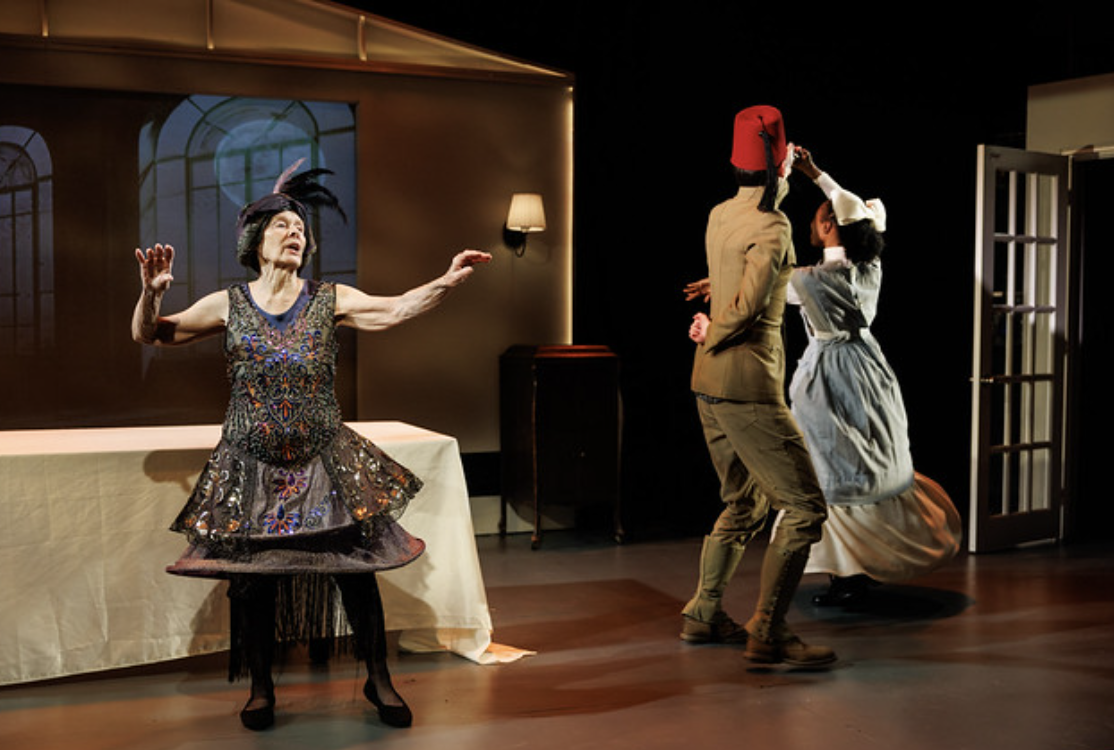
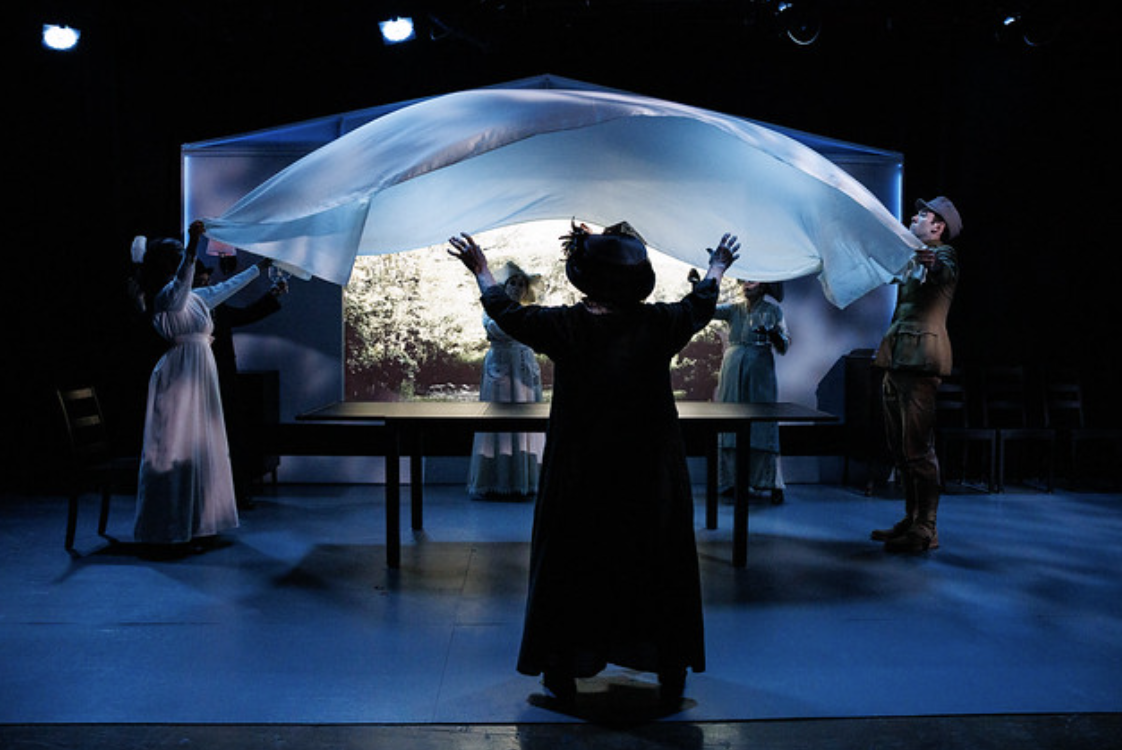
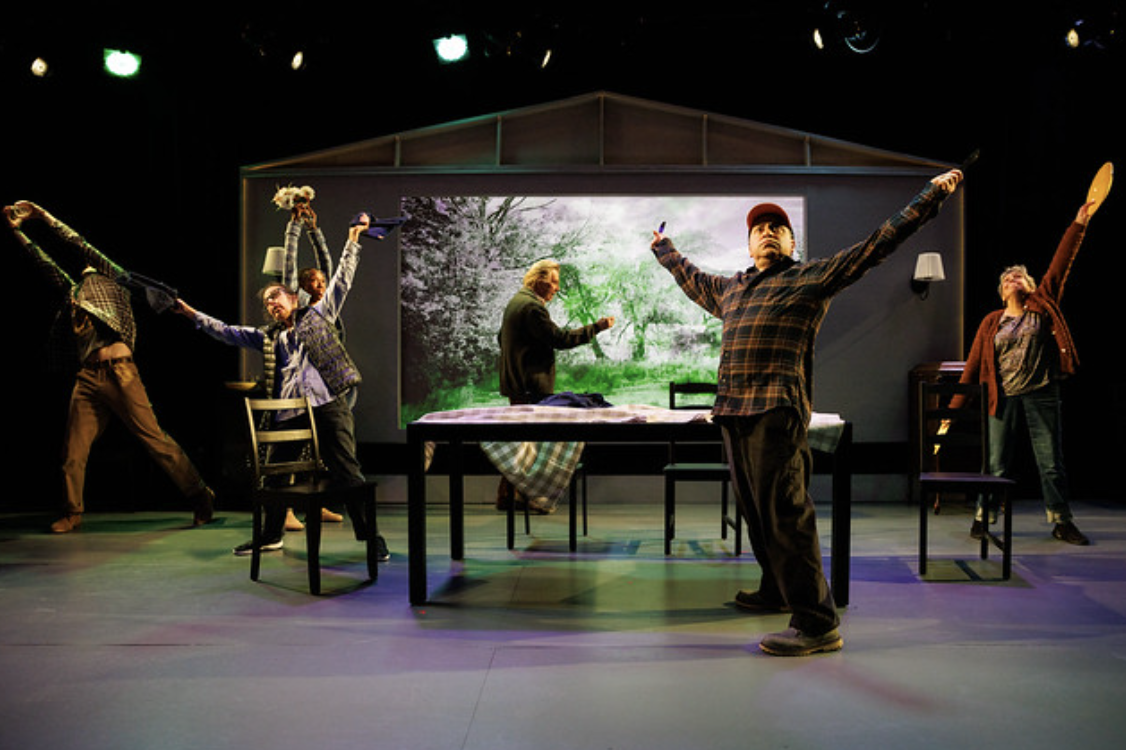
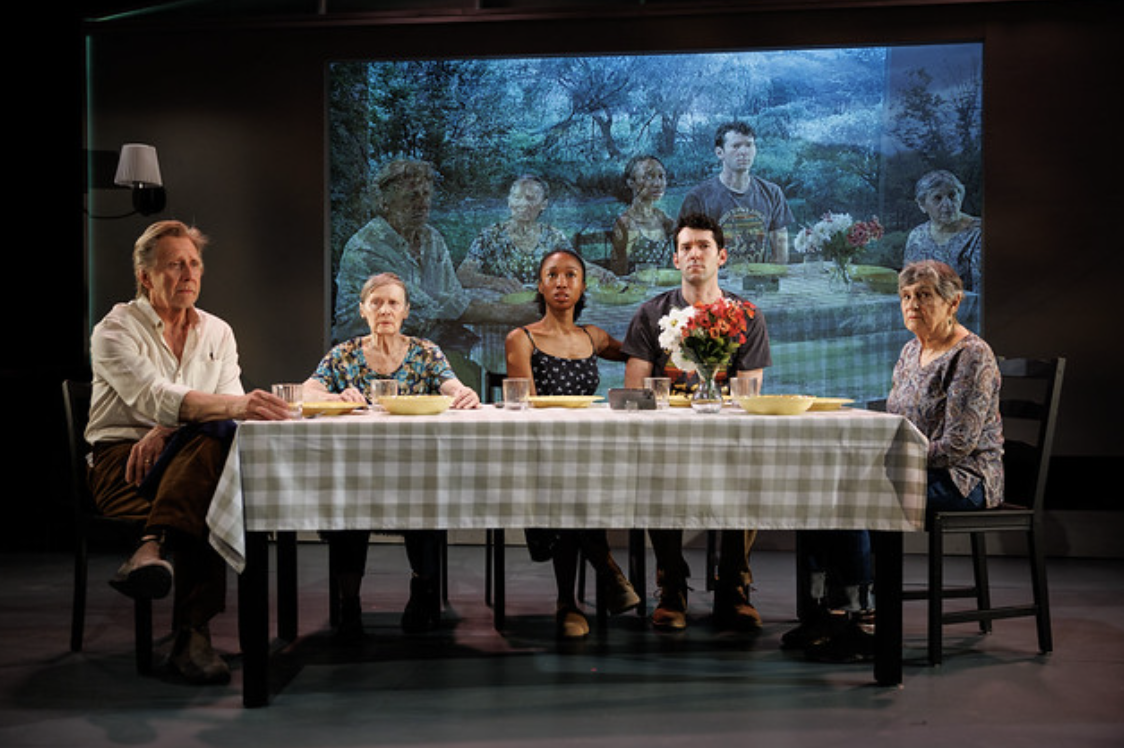
Photo credit by Maria Baranova
Five reviews of Paul Zimet's The Door Slams, A Glass Trembles have appeared in print, and they have settled on the same vocabulary: dreamy, balletic, telepathic, languid, a meditation on time. Not one of them mentions kairos. Zimet defines the term himself, in the program note: the ancient Greek god of the crucial moment, depicted with a single forelock. Grab it as he runs toward you and the moment is yours. Miss it and the god speeds past. Zimet closes the note with his thesis: his interest is in "time's complex incarnations, as well as those crucial, brief moments when they have a chance to affect their future." The reviews have flattened a play with teeth into a piece about mood. The production is luminous, yes. It is also pointed.
The target is a particular American posture circa 2026: the post-COVID retreat of the professional class from the political life of a country under its second Trump administration. Marc and his wife are research scientists who have left the city for a country house ahead of retirement, ahead of the years of work they could still be doing. Their son and daughter-in-law arrive with a new baby. Local friends drift through for dinners. There is wine and conversation and the slow accumulation of evenings. Marc, played by Jack Wetherall with the brittle vigilance of a man who has not made peace with his own withdrawal, knows the retreat is wrong. He says so. He is frustrated by the political climate and knows this is no time to be sitting back. The play does not redeem the retreat by giving it lyricism. It lets it sit there, beautiful and dishonorable.
A young local logger has been clearing the nearby forest in plain view of the country house. The household watches him daily, with the helpless attentiveness of people who have substituted viewing for doing. He is killed in a logging accident. Marc and his wife use the death as a reason to accept a research position in Europe. Their local friends, the people whose dinners they have shared and whose lives they have woven themselves into, experience the leaving as a betrayal. The play knows it is a betrayal. It also knows the leaving is the right call. The script's intelligence is in refusing to resolve the two.
Running through the contemporary timeline is a second one: a tuberculosis sanatorium in the Swiss Alps, early in the 20th century. Zimet has acknowledged Thomas Mann's The Magic Mountain as the play's central source. Mann's 1924 novel sends Hans Castorp, a young man from the German lowlands, to visit his cousin Joachim at a Davos sanatorium where Joachim is being treated for tuberculosis. Castorp plans a three-week stay. He is diagnosed with the same disease and ends up staying seven years, while the world below the mountain marches toward the First World War. The sanatorium residents in Zimet's play are dying the same slow death, filling their hours with the same gossip, the same dinners, the same waiting. Mann devotes the first 180 pages of his novel to Castorp's first three weeks at the sanatorium and the next 180 to nearly a year that follows, and the reader's experience of time deforms to match. Zimet borrows the deformation. The dinner that ended ten minutes ago is still happening, only now it is happening in Davos in 1907. By the end of seventy minutes you have lived through both a year in a country house and a long slow death in the Alps, and Zimet has trusted you to feel the shape of that without being told what to feel.
The production's most poignant moment lands at the climax of the sanatorium sequence. An absent friend's glass rises from the table on its own, as if a hand we cannot see is still there to lift it. The impressions we leave behind outlast us. Zimet refuses to underline the moment with dialogue, and the moment doesn't need it.
There is a third literary echo, and the play names it itself. In a throwaway joke between the visiting couple earlier in the script, one of them invokes Turgenev's A Month in the Country. Turgenev's mid-19th-century Russian play, often called a forerunner to Chekhov, unfolds on a country estate where the arrival of a young tutor exposes the unspoken desires of the household and undoes its equilibrium one scene at a time. The connection runs deeper than the joke: the country house, the visiting outsider, the slow erosion of equilibrium under the pressure of who arrives and who leaves. Zimet is working in a tradition where the domestic interior is itself the historical event, where the rural household is not an escape from the world's drama but the place where it concentrates.
Flannery Gregg's choreography earns more than "balletic." Around the dinner table, the ensemble cycles through near-identical sequences. Plates set, cleared, set again. Conversations loop. The same gesture returns a beat shifted from the last time. The motions accumulate the way mundanity accumulates inside a life: hypnotic, grinding, comforting in its forgetting. This is what time looks like when you stop grasping for kairos and let the god speed past. You eat. You drink. You return to your seat. You do it again tomorrow. The cycle is nearly inescapable except by an act of will, and Marc's departure is that act, even if the play refuses to call it heroic.
Wetherall, whose credits include the title role in The Elephant Man on Broadway and Konstantin in The Seagull opposite Dame Maggie Smith at Stratford, plays Marc as a man who has spent decades being competent and has just realized competence is not the same as participation. There is a tightness in his shoulders the costume cannot hide. Tina Shepard, a founding member of Joseph Chaikin's Open Theater and one of the three artists who built Talking Band out of the Open Theater's collapse in 1973, holds the room with authority that does not need to perform itself.
The full ensemble is on the same page in a way New York stages rarely deliver, and the sync is mesmerizing. Eight performers breathe together, time their gestures to a shared internal metronome, finish each other's stage business without seam. The credit belongs to Zimet, whose direction has insisted that the ensemble is the protagonist. Several of these performers have worked together for more than fifty years. The other reviewers have been calling the result "telepathic." The word mystifies what is actually craft. These performers have spent more than half a century learning each other's breath patterns. Telepathy is just listening.
Anna Kiraly's projection and scenic work is the design standout. Kiraly, who built both the set and the video for this production and who has spent years with Talking Band layering projected images into physical space, has produced a visual environment in which the contemporary world and the sanatorium do not alternate so much as bleed. The projections do not illustrate the script. They tell you when, where, and how reality is shifting, often a beat before the dialogue catches up. Mary Ellen Stebbins's lighting tracks the temperature shifts between the two timelines without ever letting you catch the cue. Olivera Gajic's costumes set the contemporary characters' quiet bourgeois ease against the sanatorium residents' Edwardian formality, and the visual rhyme between the two dinner tables is witty and unsettling at once. Ellen Maddow's score, which she also performs from within the ensemble, keeps the production from collapsing into stasis. Her music moves the play forward when the script wants to make time stand still.
What the critical consensus has missed is that the play has questions for you. It invites you to notice what you are doing with the time you have left. The Magic Mountain frame is not a pillow for meditation; it is a warning. Hans Castorp went up the mountain for three weeks and stayed seven years while the world rumbled toward 1914. The country house couple in 2026 risks the same fate. The play is asking, with considerable urgency for a production this quiet, whether you have noticed which century you are in.
It is the rarest thing in contemporary indie theatre: a play that knows what it thinks, says it, and trusts the audience to do its own thinking. Talking Band has been at this for more than fifty years. It shows.
Click HERE for tickets.
Review by Ariel Estrada .
Published by Theatre Beyond Broadway on May 18, 2026. All rights reserved.
