
BENEVOLENCE
Created, Directed and Performed by Kevin Matthew Wong
Samuel Rehearsal Studio, The Rose Building | 165 West 65th Street, New York 10023
January 7 - January 18, 2026
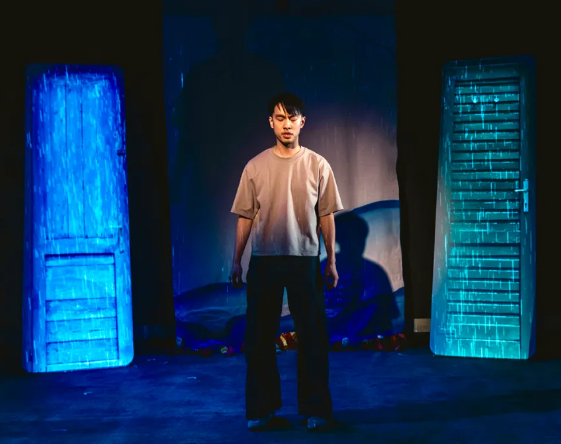
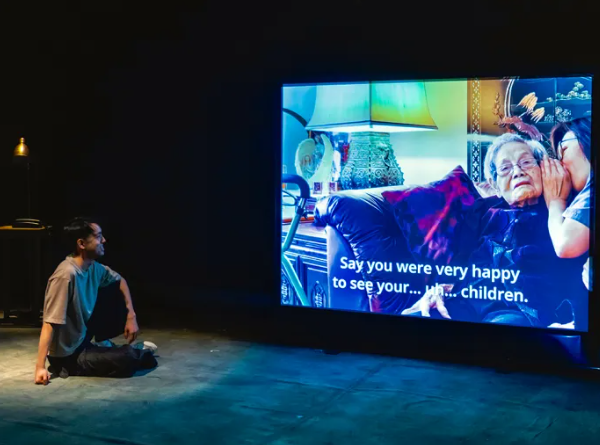
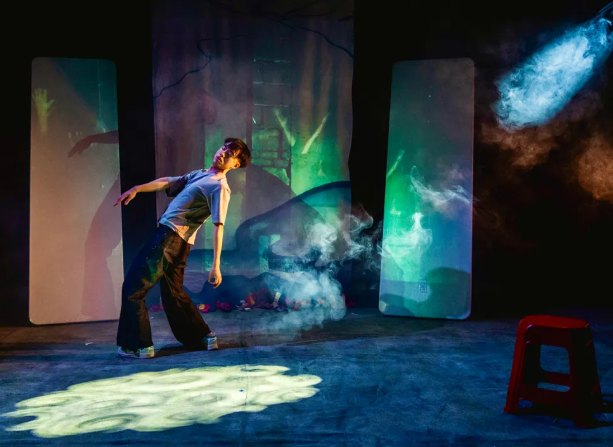
Photo Credit: Richard Termine
In Benevolence, Kevin Matthew Wong conjures a work of such disarming generosity that it seems less a performance than an act of communal grace. Hospitality—both as inheritance and imperative—animates the evening from its first moments, when Wong, with a miniature lion dance puppet in hand, ushers the audience into a participatory ritual of clanging pots and shared snacks. He reminds us that “Hakka” translates to “guest people,” and, in a production so suffused with welcome, one feels the term expand to encompass everyone in the room. Wong establishes a theatrical language that is both ceremonial and slyly contemporary. The iconography of lion dances, the reverberant clang of gongs and drums, the quiet balm of hot herbal tea—these gestures, once exoticized in Western contexts, are here reclaimed, reframed, and gently subverted. Wong treats tradition not as a relic but as pliant material, something to be handled with affection and wit. The effect is disarming: the audience is welcomed not as passive observers but as guests—participants, even—in an unfolding meditation on cultural intimacy.
Yet Benevolence resists the easy comforts of nostalgia. Wong probes, with a candor that never curdles into didacticism, the uneasy inheritance of diasporic identity: what does it mean to receive a culture in fragments? What is lost when language falters, when rituals persist but their meanings blur? As a descendant of the Hakka people, Wong illuminates a history too often flattened into obscurity. The term “Hakka”—“guest family”—emerges here not merely as an etymological curiosity but as a philosophical provocation. Who, in any given place, is the guest, and who presumes to be the host? In Wong’s hands, this question reverberates far beyond its origins, becoming an incisive lens through which to view the layered, often uneasy fabric of contemporary multicultural life.
In Benevolence, the singular and searching artist Wong offers not so much a solo performance as an act of cultural conjuring—an intimate, kaleidoscopic séance in which memory, inheritance, and imagination flicker into vivid, living form. To describe the piece as a journey of self-discovery feels almost reductive; it is, more precisely, a reconstitution of self, assembled from fragments of family lore, diasporic dissonance, and the tender absurdities of trying to belong to more than one world at once.
Wong’s subject is, in part, absence: a diasporic history scattered, occluded, and too often excluded even from the institutions designed to shelter it. The Hakka, arriving in Canada during the railroad-building era, found themselves rebuffed by the very Chinese benevolent associations meant to provide refuge. From this rejection, they fashioned their own networks—temples, Tsung Tsin Associations, even international gatherings—yet these histories lingered, for Wong, as faint impressions at best. The play’s inciting incident—a politely insistent request from a family friend to create a work for a Markham Hakka seniors’ association—becomes the thread he follows into a tapestry at once intimate and immense.
Formally, the production is as nimble as it is evocative. Wong’s integration of video, projection, and soundscape transforms the black box theatre into a porous space where past and present cohabit. A home-video sequence—featuring Wong and his centenarian grandmother—achieves a quiet, devastating grace. Their conversation falters, haltingly constrained by language and time, yet something more essential flows between them: an unmistakable current of recognition, of love unimpeded by comprehension. It is in such moments that Wong’s artistry reveals its deepest reserves of restraint and truth.
What distinguishes Benevolence from more familiar “journeys of identity” is its exquisite calibration of tone. Wong marries a gently self-mocking skepticism (“existential turbulence,” he confesses, in the face of his own perceived inauthenticity) with a luminous sincerity that never curdles into sentimentality. His dramaturgy is layered and recursive: scenes peel back to reveal not only history but the mechanisms by which history is constructed. The filmed interview with his grandmother trembles with poignancy, only for Wong to expose, with wry candor, the scaffolding behind it—the prompting, the familial coaxing, the paucity of usable footage. The effect is not deflationary but clarifying. Memory, the play suggests, is both fragile and collaborative, an artifact shaped as much by love as by fact.
The narrative unfolds with a documentarian’s curiosity and a poet’s instinct for metaphor. Wong traces his reluctant beginnings through a pilgrimage to Victoria, where encounters with a local Hakka association and the quietly resonant Tam Kung temple awaken in him a sense of continuity that feels earned rather than inherited. Along the way, he is buoyed—and gently hectored—by the irrepressible Sonia, a Jamaican Hakka elder whose comic verve and moral clarity provide the production with one of its most indelible presences. Her refrain—that gatekeeping identity ensures its extinction—lands with the force of lived wisdom.
The production’s theatrical intelligence is evident in every detail. Under Wong’s own deft direction, the stage becomes a site of continual transformation. Echo Zhou’s set and lighting design is both playful and precise: an oversized dim sum steamer doubles as a pincushion; projections alight on upended tables to conjure temple doors and liminal thresholds; a screen rises from the floor as if summoned by memory itself. Composer and Sound Designer Chris Ross-Ewart threads the piece with an insistent ringtone—at once the voice of Sonia and the echo of Wong’s own conscience—binding the episodic structure into a cohesive emotional arc.
Still, for all the technological finesse, it is Wong himself who commands the stage with a magnetism that feels at once effortless and exacting. Over ninety uninterrupted minutes, he performs a virtuosic feat of embodiment, slipping in and out of a chorus of figures—nosy uncles, watchful aunties, familial archetypes rendered with both precision and affection. His transitions are so fluid, so finely observed, that the stage seems briefly to teem with unseen presences. He sings, he dances, he jokes; yet beneath the buoyancy lies a rigor of craft, a meticulous shaping of tone and rhythm that keeps the work from ever drifting into indulgence.
For all its formal sophistication, Benevolence remains anchored in the ineffable warmth of Wong’s presence. He embodies and gently parodies a gallery of figures—elders, relatives, even himself—with an affection so palpable that the audience cannot help but return it. There are no easy generalizations here, no flattening of difference into digestible tropes; even within the seniors’ community, debate persists about who has the right to tell which stories. Wong does not resolve these tensions so much as hold them, delicately, within the larger gesture of invitation.
He possesses a comedian’s instinct for timing, for the perfectly placed aside, but also a willingness to linger in vulnerability. His humor—self-deprecating, inquisitive, edged with wonder—never diminishes the stakes. Instead, it becomes a means of access, a way of inviting the audience into more difficult recognitions. He laughs at cultural dissonance, at his own moments of naïveté, but always with an undercurrent of inquiry: what, exactly, are we laughing at, and why?
In the end, Benevolence unfolds as a meditation on belonging that feels both deeply personal and quietly expansive. It concerns itself with the fragile persistence of culture—the ways it is misremembered, reinterpreted, and, against all odds, sustained. Wong suggests that connection need not be perfect to be profound; that even across gulfs of language, time, and understanding, something essential endures.
There is, too, an echo of Zhuangzi in Wong’s sensibility—the sense that identity itself is mutable, dreamlike, in constant negotiation between what is inherited and what is imagined. In Benevolence, this fluidity becomes not a source of anxiety but of possibility. Wong does not ask us to choose between worlds. Instead, he shows us how to inhabit them more fully, more generously—how, in the delicate interplay between past and present, we might begin to recognize ourselves anew.
If no single work can encapsulate the totality of Hakka identity, Benevolence comes as close as one might hope—not by claiming authority, but by modeling attentiveness. It is a play about listening: to elders, to history, to the quiet urgencies of one’s own inheritance. Wong offers it, with characteristic humility, as a kind of open-handed gift. One leaves the theater not only moved, but newly attuned—to the stories that surround us, and to the simple, radical act of welcoming them in.
For info on 2026 Under The Radar, visit https://www.utrfest.org
Review by Tony Marinelli.
Published by Theatre Beyond Broadway on March 31th, 2026. All rights reserved.