TESTO
Created, directed, and performed by Wet Mess
Dixon Place, 161A Chrystie Street, New York, NY 10002
January 13 - 17, 2026
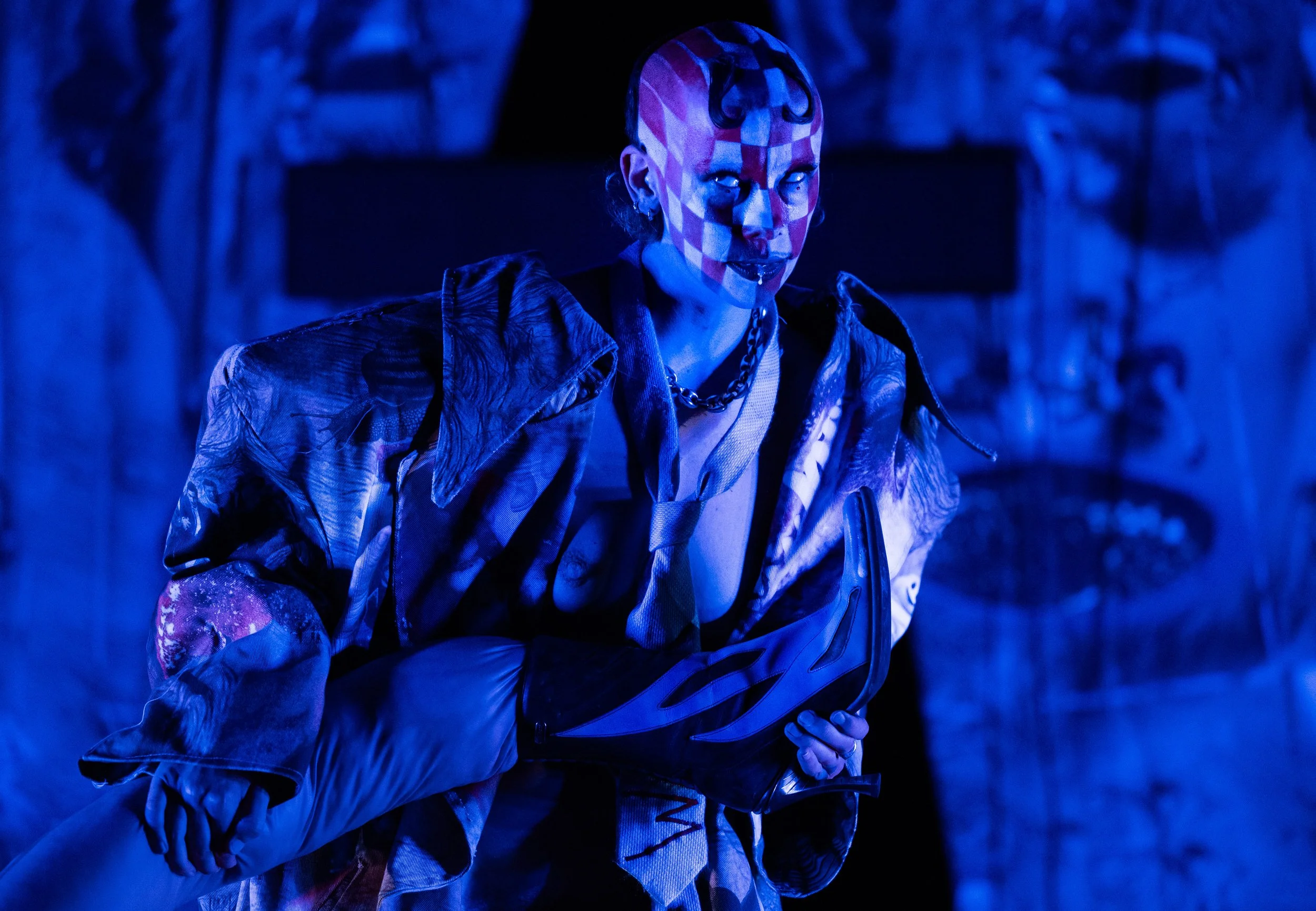
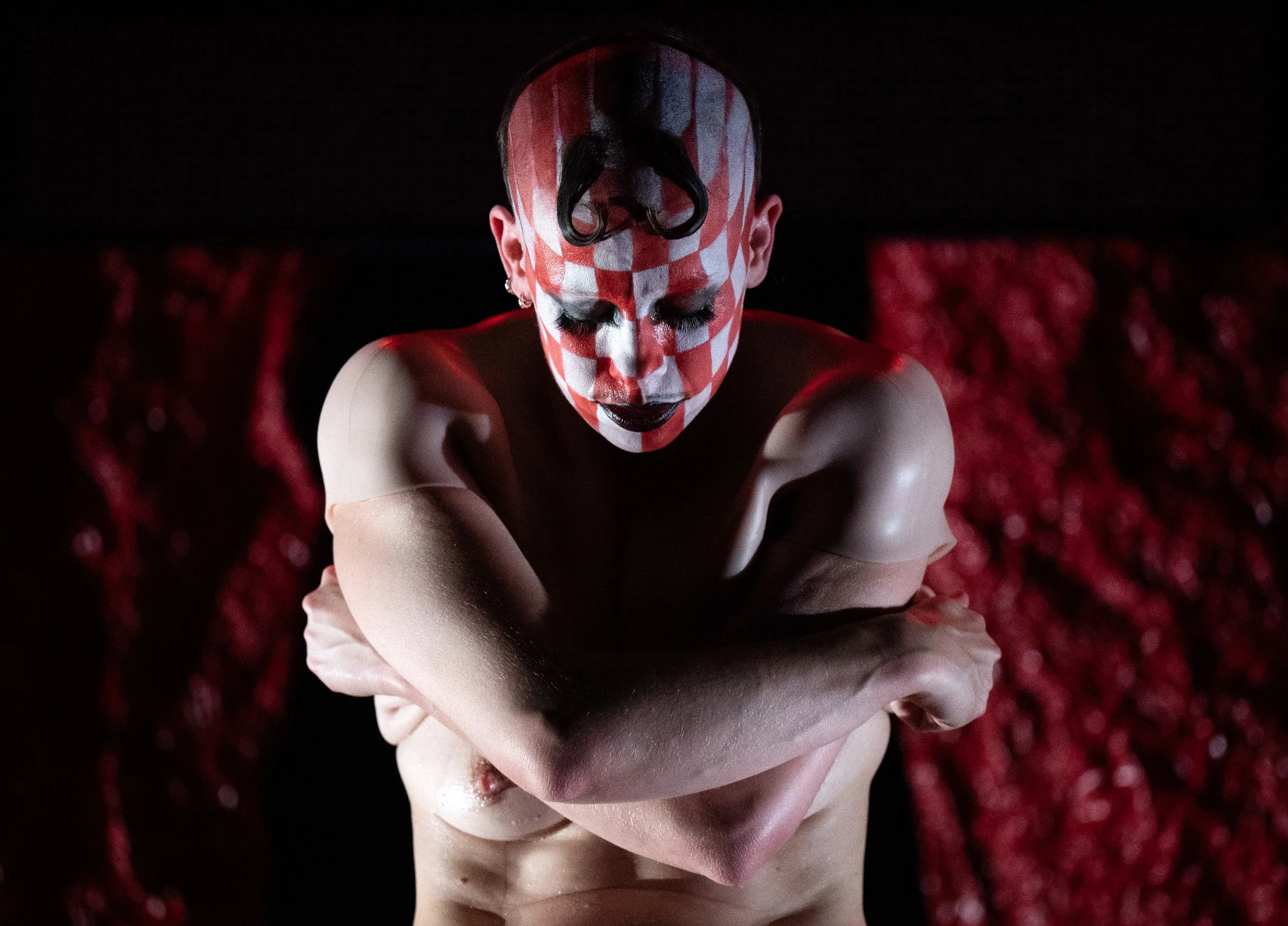
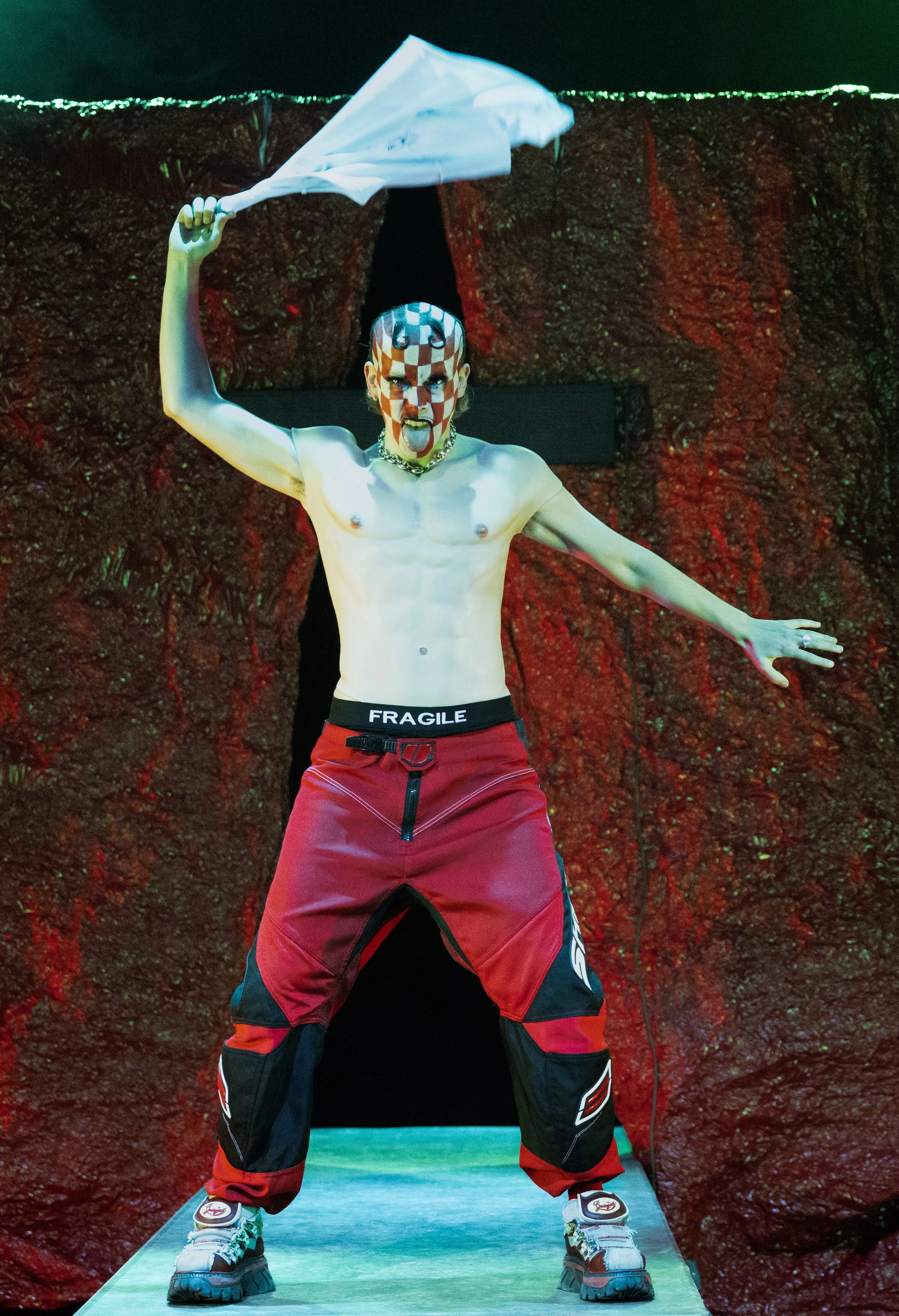
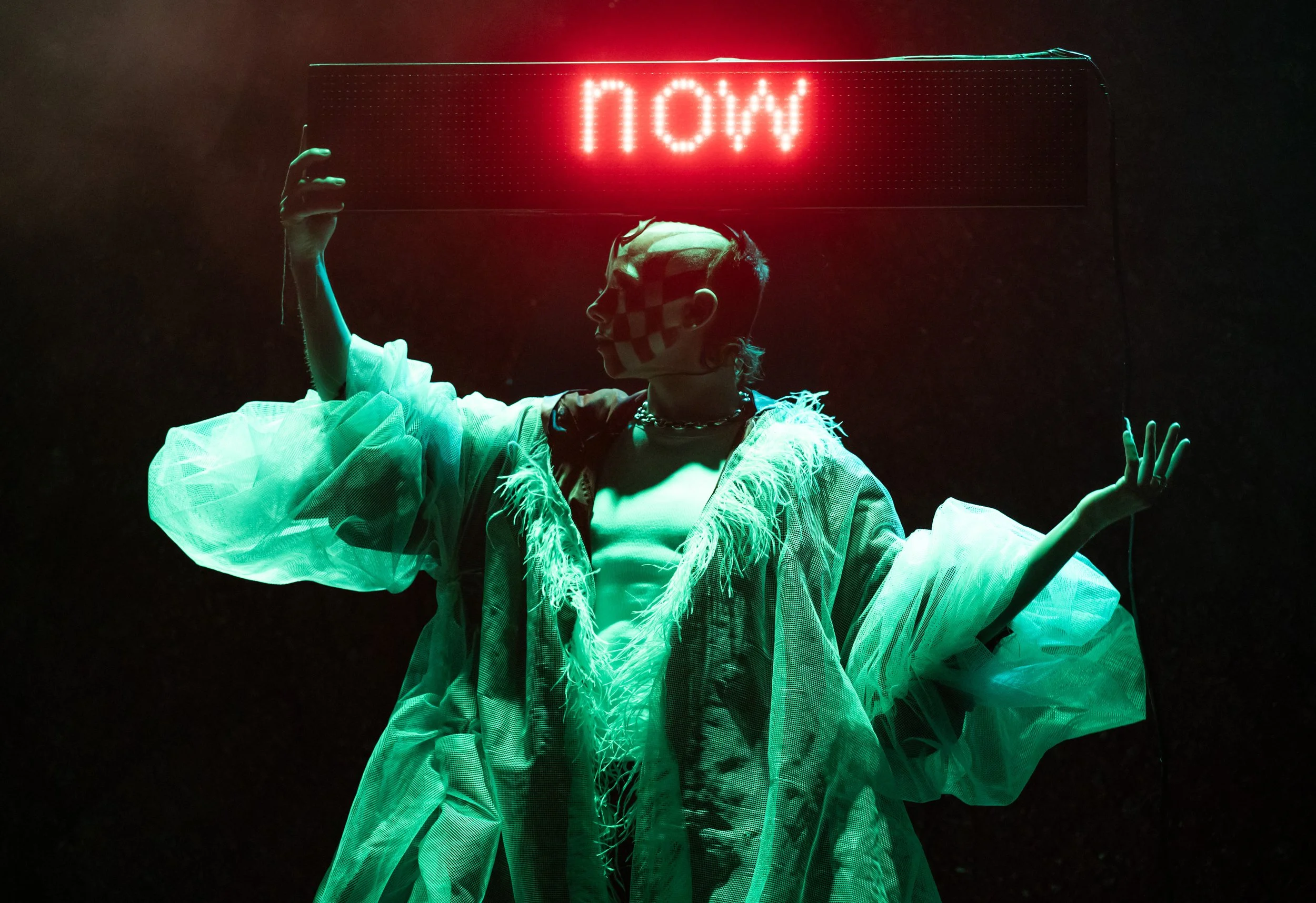
Photo Credit: Lesley Martin
About 25 years ago I met my first trans-exclusionary radical feminist. She was a co-worker, proudly self-described, and her argument was essentially that trans women were leeching off the labor of real women. Last year I met a colleague who opens every conversation about transness with an affirmation of trans support and then spends ten minutes explaining why the specific embodied suffering of cisgender women, state control over reproductive choices, the physiological demands of menstruation and pregnancy, should not be conflated with the experiences of trans women. She was not, she wanted me to know, a TERF. She was just being precise. The distance between those two positions is smaller than either of them would like. Both are verification: a demand that trans people prove their suffering matches a pre-approved template before the welcome mat comes out. One uses a hammer. The other uses a scalpel. The wound is the same.
I want to be transparent about where I am coming from. I have taught, mentored, and collaborated with transgender, gender-expansive, and nonbinary people across my career as both educator and artist. Growing up gay in the middle of the AIDS crisis is its own education in what it means for the state to treat your body as a problem to be managed and your community as a casualty acceptable to ignore, and it made me someone who believes, with particular ferocity, that we MUST be in the face of a world that would rather not look. Where I have been is another matter. There was a time, younger, hormonally overcommitted, sharing eyerolls with a doctor boyfriend, when I could not parse the trans experience at all. I started to write a version of that in this very article, a line that has worked as a bitchy gay anecdote for years, and then I stopped myself. What I was about to put on the page was contempt dressed as wit, misogyny hiding inside the comedy. Exactly the kind of self-capturing that TESTO is in the business of forcing.
Across the 2026 Under the Radar Festival, two shows kept dismantling the same thing: the structures power builds around bodies it wants to control. In DARKMATTER, the demolition aimed at scenic architecture. In TESTO, it aimed at fabric and skin. Different communities, different aesthetics, identical refusal: we are not what you have made of us.
TESTO is a drag and movement work built from choreography and a soundscape of pre-recorded interviews. It doesn’t negotiate with the gender police. It refuses the premise that gender is a stable binary, and it refuses the gatekeepers who try to enforce it. The runway stage frames all of this with precision: a runway is a machine for appraisal, built for the organized pleasure of judgment. Wet Mess uses it as a confrontation with every detractor who claims the work is only using transness as shock value, and with the transmedicalist position that without visible medical transition the identity is performance rather than truth. The runway answers both: yes, you came to watch a body. Here it is. Now account for what that watching means.
I sat in the front row, which was not a metaphor. It was a contract. At certain points I had an unobstructed view of explicit self-pleasure, close enough that the performance could not be processed as an idea or symbol. The sweat, heat, and physical evidence of a body working at the limit of its capacity were present in the room with an immediacy that polite theatre does not usually permit. I keep thinking about the moment in David Cromer’s 2009 Off-Broadway revival of OUR TOWN when bacon is cooked onstage and the sensory register of the form expands beyond the fourth wall. This was that, except the stimulus and the associations were different in almost every possible way. Wet Mess makes their genitals visible and makes no attempt to manage your access to that information. In a political moment that tells trans and gender-expansive people that their bodies are nobody’s business, the show seems to be arguing that sometimes radical visibility is its own form of refusal. Not privacy as strategy. Exposure as defiance.
The recorded interviews, credited by name in the program, Trans Punk Elder, Baby, Angel, Shrek666, Santi Sorrenti, Danni Spooner, Sue Maclaine, Svar Simpson, Felix Mufti, Ben Vyle, are curated with clear intent. The voices describe the effects of testosterone: sex drive, muscle, smell, voice shifts, clitoral enlargement, hair loss anxiety, the fleeting feeling of owning the space on a crowded bus. The soundscape builds a case not against testosterone as necessary care for those who need it, but against the cultural mythology that testosterone confers legitimacy, authority, worthiness to take up space. Wet Mess has consistently declined to disclose their own hormone status, placing the question in the same invasive category as demanding to know what is in someone’s pants. The body they present onstage is not visibly masculinized by exogenous testosterone, and the show treats that as structural rather than incidental: you do not need to pass through a medical checkpoint to have standing in this conversation. Transition is not a checklist. There are infinite ways to be trans.
Midway through the piece there is a sequence built around butter, an extended fantasy of submersion in something rich and yielding and frictionless. One reviewer confessed they were completely lost by it. I was not lost. I was hungry and slightly sick at the same time, the way you feel after eating the hot fat off a steak rather than cutting it away, something delicious and borderline wrong, a second of your life sliding pleasurably off the bone. In a piece that keeps pressing on the violence of gender policing, the butter bath reads like a utopian prank: a moment where the body slips free of the binaries that surveil it, made slippery and warm and uncontained. The absurdity might be the point. Wanting it and feeling uneasy about wanting it is exactly where the sequence intends to put you. Utopia is always a little ridiculous when you are standing inside the constraints it would dissolve.
The show has a sequence with a latex torso, the kind used by some transmasculine people as part of gender-affirming care. Wet Mess spends real time trying to absorb it, pressing it into intimacy the material keeps refusing. The choreography reads like bargaining with something that is supposed to help but keeps imposing its own terms. Eventually it collapses into anger and they rip it off. I felt that exhaustion as if it were my own: the specific fatigue of code-switching, of butching it up to stay safe in a room that might not be, of performing the version of yourself that passes while the real one holds its breath backstage, waiting for the space where you can finally stop. A chrysalis in reverse: not transformation into an approved form, but refusal of the form as the price of being believed. The ripping is not triumphant. It is exhausted. And watching it, for a long moment, so was I.
The design works as a single, coherent argument about the body as contested territory. Ruta Irbite's set turns the drag runway into something closer to an abattoir, lined with a corpse beige Victorian English Country tapestry that substitutes nudes and dismembered body parts for pastoral scenes, its phallic pillows deployed as furniture, clothing, and weapons with equal parts violence and comedy. Lambdog1066 delivers the costume climax by ripping that same fabric directly off the set. The result is a science fiction double feature robe with leg of mutton sleeves large enough to be T-rex legs, a flowing train of flesh and body parts, and licorice vinyl ultra high-heeled chunky boots that looked good enough to devour. Paired with Wet Mess's signature houndstooth makeup, the total effect lands somewhere near Alexander McQueen's most aggressive statement pieces. Set and costume are not separate departments here. They are the same argument, worn. Josh Hariette's lighting drives the temperature throughout, moving from hardcore techno club, all strobe and color washes and seductive manic darkness, to a single late sequence lit like a beautiful summer afternoon, a genuine surprise that earns its warmth. Baby's sound design closes the room around you: industrial hardcore cut with trans testimony and conservative political soundbites on all sides, and when the silence arrives, it is not a reprieve. It is louder than everything that came before it.
The ending earns its peace. Wet Mess rests on the phallic pillows they have been dancing with and against and through, and the piece allows a moment of genuine stillness. A body settled into its own authority, unconcerned with anyone’s timeline for understanding it. TESTO made me a wet mess of contradictions about how to live with integrity in a moment when the forces working against trans communities are organized and funded and not interested in nuance. I think the show would take that as a success. It offers no reassurance to people who treat gender as biology-only, binary-only, and enforceable. It insists, on its own terms, that you are the only authority on your own gender, even when that is messy, even when it is funny, even when it refuses to resolve into something that makes everyone comfortable. I keep thinking about those two women from the beginning of this review, the one with the hammer and the one with the scalpel, and the sadness I feel is not abstract. It is the sadness of watching people codify and restrict and wound from a position they have decided is precision. Both would leave TESTO confident they had not been addressed. They would be wrong.
For info on 2026 Under The Radar, visit https://www.utrfest.org
Review by Ariel Estrada.
Published by Theatre Beyond Broadway on March 31th, 2026. All rights reserved.