Birdie
Created by Àlex Serrano, Pau Palacios, and Ferran Dordal; Performed by Àlex Serrano, Pau Palacios, and David Muñiz
Clark Studio Theater The Rose Building | 165 West 65th Street, New York 10023
January 14 - January 18, 2026
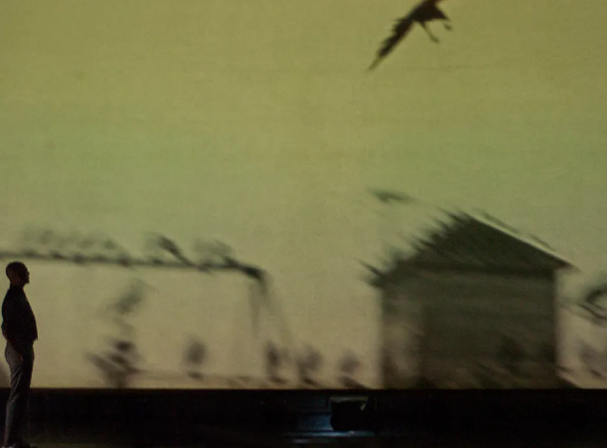
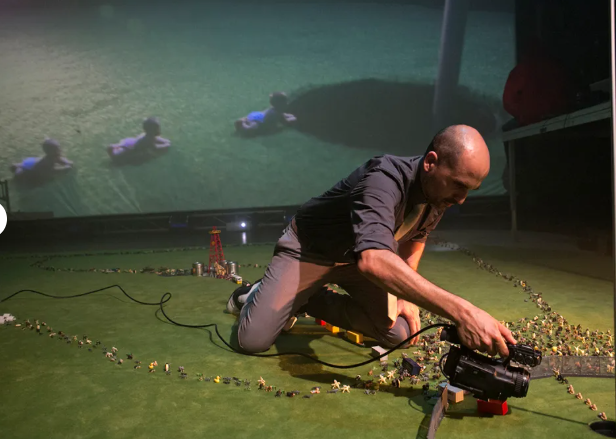
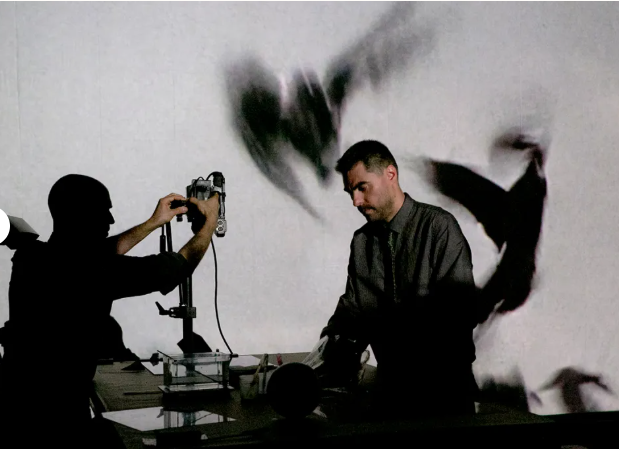
Photo credit: Lawrence Sumulong
In golf, a birdie is one stroke under par. One better than expected, one closer to the hole. Agrupación Señor Serrano’s decade-old multimedia piece of the same name, arriving at Under the Radar via Lincoln Center’s Clark Studio Theater, begins with the game and ends with the hole. Their three performers in suits, ties, and golf shoes move across the stage with the focused economy of caddies who already know the score. The hole-in-one in this round is oblivion.
The stage is an astroturf green. The synthetic turf is laid flat, carved with its hole, surrounded by scale models and cameras and 2,000 miniature animals the company will spend sixty-five minutes manipulating into a live cinema of planetary emergency. Consider what that surface represents outside this theater: US golf courses alone apply 80 million pounds of pesticides annually, 98 percent of which miss their intended target species and leach instead into soil and groundwater, running off into waterways where they trigger eutrophication, the nutrient overload that spawns algal blooms and chokes aquatic life. American courses drain 1.5 billion gallons of water per day. In Thailand, a single course consumes as much water as 60,000 rural villagers. Over 2 million acres of American land are kept artificially, extravagantly green at the cost of the native habitats, wetlands, and forests that were cleared to plant them. The performers walk this green in golf shoes. They know what they’re standing on, and so do we, by the time they’re done with us.
The piece turns on a photograph taken by Spanish photojournalist José Palazón in October 2014, on a golf course in Melilla, Spain’s autonomous exclave on the northern Moroccan coast. In it, a group of African migrants cling to the border fence above the green while European golfers play below, one of them glancing upward. Señor Serrano’s forensic analysis of this photograph, delivered through Simone Milsdochter’s cool English voiceover, is the show’s argumentative spine: a lesson in composition, in the golden ratio, in what the eye does and doesn’t choose to see. The photograph tells us, Milsdochter tells us, everything about the architecture of looking away.
BIRDIE is not a documentary. It is something stranger and more demanding: a piece of hard pop, where shared cultural references (Hitchcock, golf, the common swift, Noah’s Ark) are lifted and twisted until what’s inside them spills out. The Hitchcock material is deployed not for the birds themselves so much as for the specific species of dread they produce: the irrational conviction that what is foreign is inherently threatening, that the flock on the wire is a declaration of war. This is a paranoia Señor Serrano stages not as aberration but as policy.
Across four acts whose titles escalate with grim inevitability (They’re Coming; They’re Birds, Aren’t They?; They Never Stop Migrating; Is This the End of the World?), the piece traces a causal chain that nobody in power will name plainly. Environmental destruction feeds political instability. Political instability generates forced displacement. From there, displacement meets the fence, the golf course, the policeman looking up, and the golfer who glances and returns to his swing. The chain does not stop there. It continues past the fence, past the green, past all of them, toward what the final image will not let you avoid.
The three performers function as puppeteers and cinematographers simultaneously, handling cameras with the focused tenderness of people who understand that what gets framed is what gets seen. This is, first and last, a live performance: the seams showing, the hands visible, the whole gorgeous apparatus of illusion constructed in real time in front of you. It pulls from visual art installation and experimental film without belonging to either, landing somewhere theatre alone can go, and it is as moving and as purely enjoyable as any play you will see this season. The scale model sequences, particularly the mass migration of miniature animals across the green, are vertiginous: projected enormous on the upstage screen, what looked like plastic toys becomes a catastrophe in motion. The strobe-and-smoke passage pulls you under. Roger Costa Vendrell’s jazz-inflected score runs beneath everything like groundwater, present before you register it, impossible to locate once you have.
The voiceover maintains the temperature of a surgeon explaining a procedure. It does not ask for pity. It does not offer comfort. It notes that people trust images because questioning them would mean questioning the comfort of their own existence. The observation lands like a diagnosis. Then comes the final image: a figure at the front of the stage, a bag over their head, in a posture that summons a prisoner before a firing squad before the mind makes the connection. Behind them, a massive industrial fan drives air into the house, the wind reaching every seat, the audience breathing what the stage exhales. Milsdochter’s voice continues over it.
The image is harrowing, and also, somehow, meditative. Those two things are not in contradiction. That is exactly the problem.
Sixty-five minutes of astroturf and plastic animals does what no footage of drowning bodies ever quite can: it puts you inside the catastrophe rather than in front of it. Except you are in a seat. You bought a ticket. You came willingly. The wind the fan drives into your face is another matter. A golf course is a golf course is a planet. The hole-in-one is a hole. And something is blowing through it you didn’t buy a ticket for.
Visit https://utrfest.org/program/birdie/ for more info.
Review by Ariel Estrada.
Published by Theatre Beyond Broadway on March 31th, 2026. All rights reserved.