MY JOY IS HEAVY
Created & Performed by The Bengsons, Directed by Rachel Chavkin
Choreographed by Steph Paul, Music Supervision by Or Matias
New York Theatre Workshop | 79 East 4th Street, New York, NY 10003
February 25, 2026 - April 12, 2026
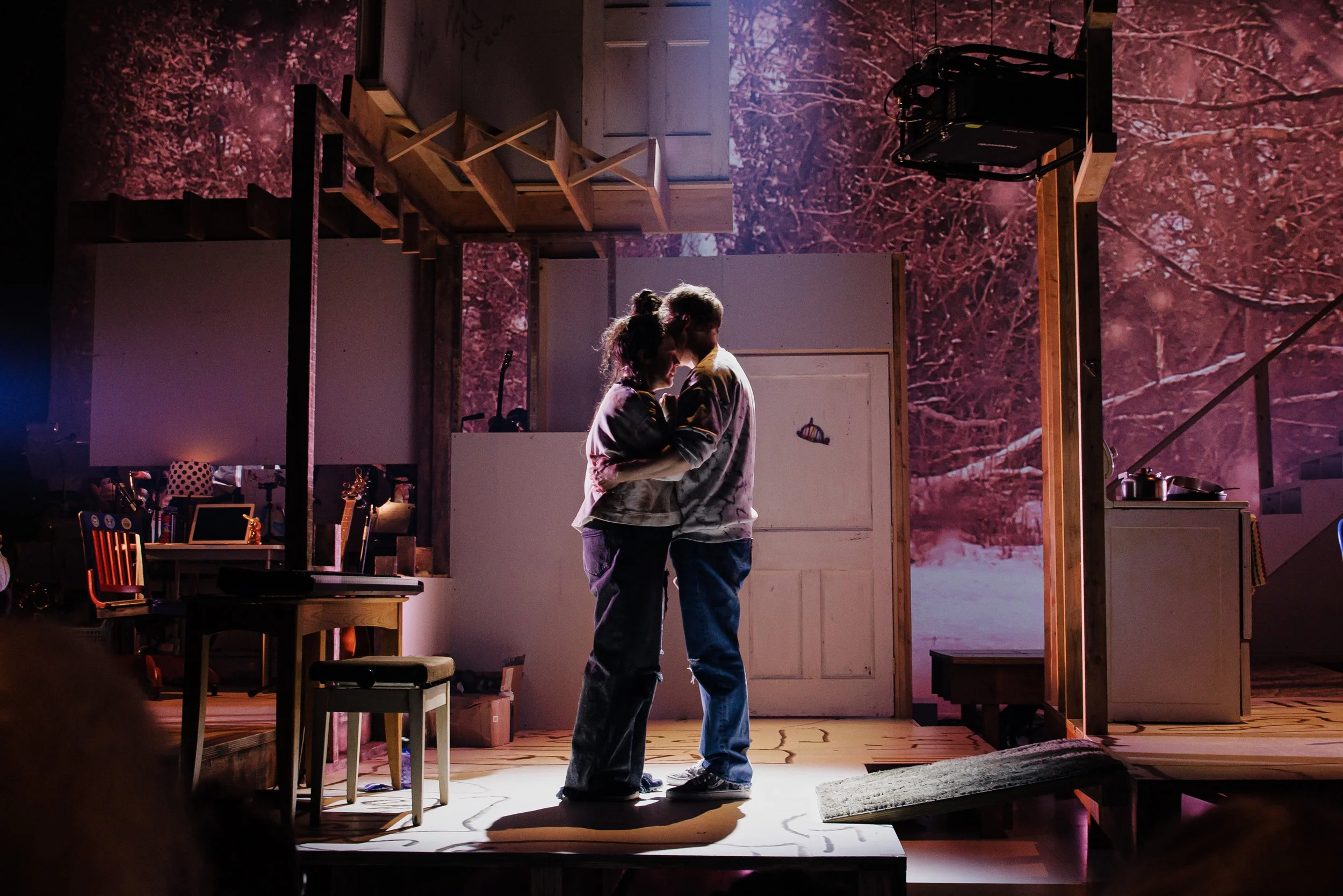


Photo credit by Marc J. Franklin
There are, to be sure, subjects that seem to resist the consolations of musical theatre—experiences whose intimacy or anguish threatens to curdle under the bright insistence of song. Infertility, chronic pain, miscarriage: these are not, on their face, tap-dance material. To set such a story amid the still-fresh psychic debris of the Covid-19 pandemic might appear, at best, perverse, and, at worst, self-defeating. And yet Abigail Bengson and Shaun Bengson have made a career of walking directly into such fires. Their earlier works—Hundred Days, The Lucky Ones, and The Keep Going Songs—all share a refusal to avert the gaze. With My Joy Is Heavy, now receiving its world première at New York Theatre Workshop under the supple direction of Rachel Chavkin, they extend that project into territory at once more domestic and more harrowing.
From the outset, the Bengsons leaven their material with humor—disarming, self-aware, and faintly anarchic. Abigail, addressing the audience with the breezy candor of someone who has long since abandoned the pretense of decorum, announces the performance as “relaxed,” adding that, given her pelvic-floor therapy, she herself is “peeing right now.” The line lands not merely as a joke but as a thesis: the body will not be tidied for public consumption.
The musical unfolds as a kind of chamber memoir, charting the couple’s attempt to conceive a second child while sequestered in Abigail’s mother’s cluttered Vermont home that hovers, —rendered with meticulous, teetering specificity in Lee Jellinek’s set—emerging as a space she wryly characterizes as “less Norman Rockwell and more Donner Party,” a mordant formulation that neatly captures its uneasy blend of homespun nostalgia and encroaching chaos. Time feels suspended there, as it did for so many during lockdown, even as the body insists on its own unruly timelines. The Bengsons, playing versions of themselves, confront the indignities of medical intervention, the distortions of telehealth, and the creeping suspicion that the very drugs meant to assist conception may be conjuring hallucinations. Meanwhile, the gravitational pull of their young son, Louie, and the guilt of absence—emotional as much as physical—presses in from the margins. Hovering over everything is the memory of a pregnancy lost, a prior grief that renders each flicker of hope newly perilous. To write about such a work is to approach a delicate boundary.
What emerges, in Chavkin’s finely attuned staging, is less a narrative than a field of emotional weather, in which joy and sorrow coexist not as opposites but as unstable companions. The Bengsons are particularly acute on the dissonance between expectation and lived reality—the quiet, devastating ways in which the body refuses to conform to desire. It is, as they suggest, an ancient drama, one that might have been legible to the Greeks, and yet it remains stubbornly contemporary in a culture still uneasy with the inevitabilities of illness and death. Their score, with its signature blend of indie-folk immediacy and theatrical address, becomes the medium through which these contradictions are not resolved but held in suspension.
There is, in Abigail’s performance, a distinctly unnerving sense of risk, as though the stage itself might at any moment give way beneath the weight of what is being summoned. She is asked not simply to recall her trauma but to conjure it anew before us, to inhabit it with a degree of immediacy that resists aesthetic buffering. Frequently, she proceeds without the softening veil of humor or the insulating poise of sang-froid, and the result is a kind of exposure that feels less like representation than endurance—an act of performance that edges, at times, into something perilously close to lived experience.
The Bengsons’ attempt to conceive again is shadowed by a quiet, intractable dread: what ought to be a moment of uncomplicated elation—a positive pregnancy test—arrives instead freighted with anxiety. Having been marked by miscarriage and the grueling uncertainties of her medical passage through fertility treatments, Abigail confronts a question at once intimate and philosophical: whether the act of allowing oneself joy is, in fact, a kind of wager—one that risks incurring an even greater future pain.
The material is nakedly autobiographical; the performers are its authors; the wounds it exposes are, unmistakably, real. Criticism risks straying into the impolite territory of adjudicating lived experience. But when the Bengsons’ songwriting reaches its fullest expression—as in the searching, lyrically unguarded “Easy/River”—it achieves a rare alchemy, transmuting private anguish into communal recognition. A deliriously comic sequence, in which Swiss yodeling exercises collide with the ambient noise of pandemic life—crime procedurals murmuring from a television, a child’s digital distractions—captures, with manic precision, the sensory overload of that period.
The production is buoyed by the performers’ considerable charisma and by a staging that understands the value of warmth. David Bengali’s projections, an evocative collage of home movies, lend the piece a porous temporality, while Alan C. Edwards’ lighting design shapes the space with a sensitivity to emotional gradation that borders on the musical. Nick Kourtides’ sound design strikes a careful balance between concert immediacy and textual clarity, and Hahnji Jang outfits the ensemble in a kind of studied casualness, as though a group of New England neighbors had stumbled, half by accident, into a yard sale/barbecue.
The six musicians who flank the Bengsons—Aaron Bahr (trumpet and voice), Ashley Baier (drums and voice), Noga Cabo (guitar, bass, and voice), Reginald Chapman (trombone, tuba, and voice), Matt Deitchman (keyboard, accordion, and voice, and also the production’s music director), and Nicole DeMaio (saxophone, flute, clarinet, and voice)—are not relegated to the polite margins of accompaniment. Rather, they operate as a fully realized theatrical organism, a kind of contemporary Greek chorus that does more than underscore the action: it absorbs, refracts, and amplifies the Bengsons’ grief until it becomes communal, almost ritualistic. What is especially striking is the fluidity with which these performers traverse the boundary between musician and actor. Without ever relinquishing their instrumental responsibilities—the very architecture upon which the evening’s emotional release depends—they conjure fleeting, suggestive personae, slipping in and out of the Bengsons’ psychic landscape. They are at once inside the story and in service to it, sustaining the musical engine even as they people its world, and in so doing, they render catharsis not as a solitary purge but as a collective act of bearing witness.
By the time the title number arrives, the evening has gathered a quiet, cumulative force. “My Joy Is Heavy” unfolds as a kind of secular hymn—part stomp-clap revival, part indie-folk catharsis—culminating in a procession that spills into the audience. Abigail, brandishing the two potted plants she asked audience members to plant-sit like talismans (one of the small plants, she explains, stands in for those who died in that season of suspended time; the other, for those who were born—a modest, almost homespun emblem that quietly contains the full, unbearable arithmetic of the pandemic), leads the ensemble with the fervor of a prophet of the domestic sphere, her voice cracking open into something both ecstatic and bruised. It is a gesture at once celebratory and elegiac, a recognition that joy, when it comes, carries the weight of all that has been endured to reach it.
One leaves the theatre not so much consoled as companioned—acutely aware of the fragility of the human body, and of the stubborn, necessary impulse to sing anyway.
Click HERE for tickets.
Review by Tony Marinelli March.
Published by Theatre Beyond Broadway on April 2, 2026. All rights reserved.
