CABLE STREET
Produced by 10 TO 4 PRODUCTIONS
Presented by 59E59 THEATERS AS PART OF BRITS OFF BROADWAY 2026
Music and Lyrics by Tim Gilvin
Book by Alex Kanefsky, Directed by Adam Lenson
59E59 Theaters, Theater A, 59 East 59th Street, in Manhattan
April 26, 2026- May 24, 2026
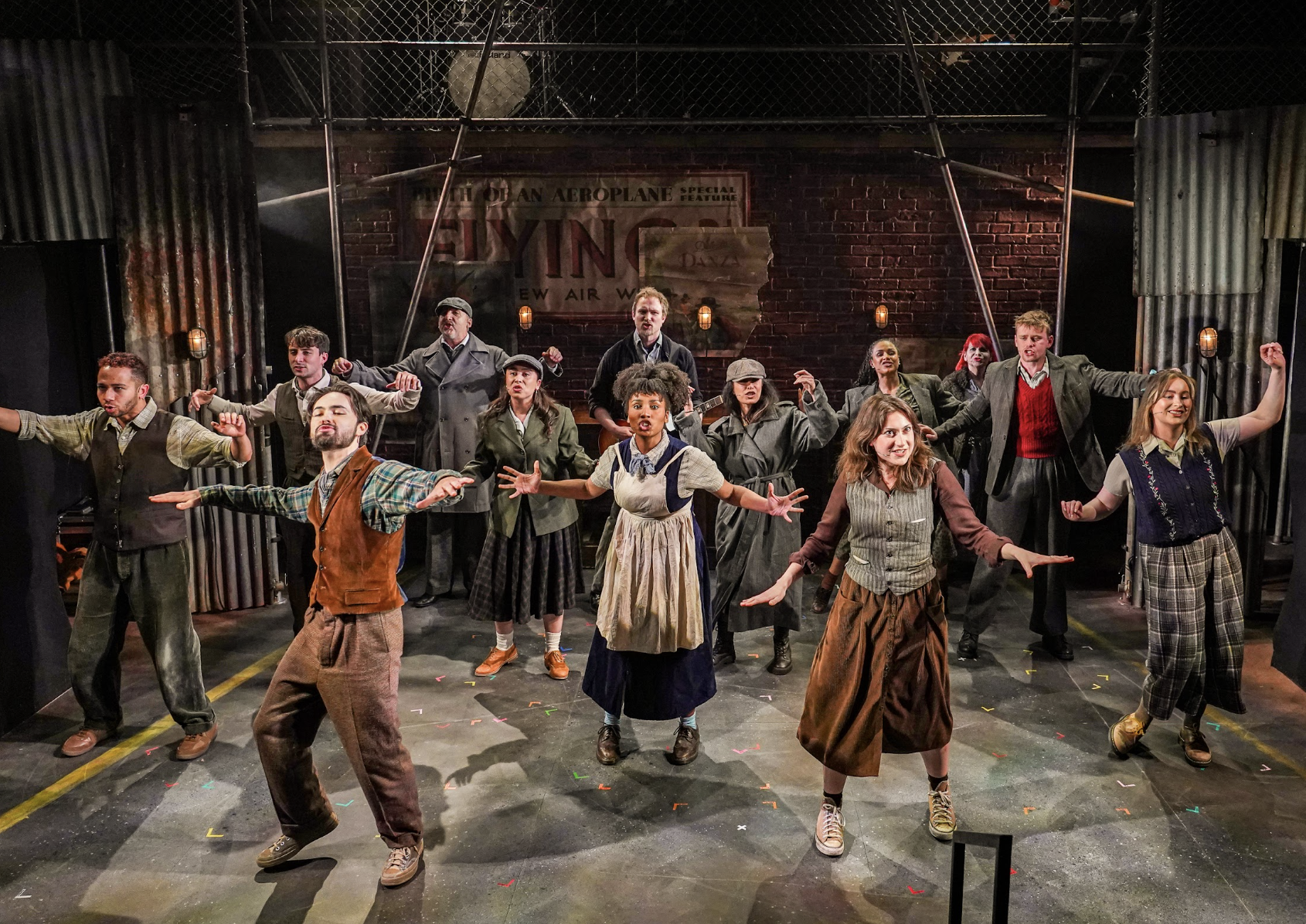
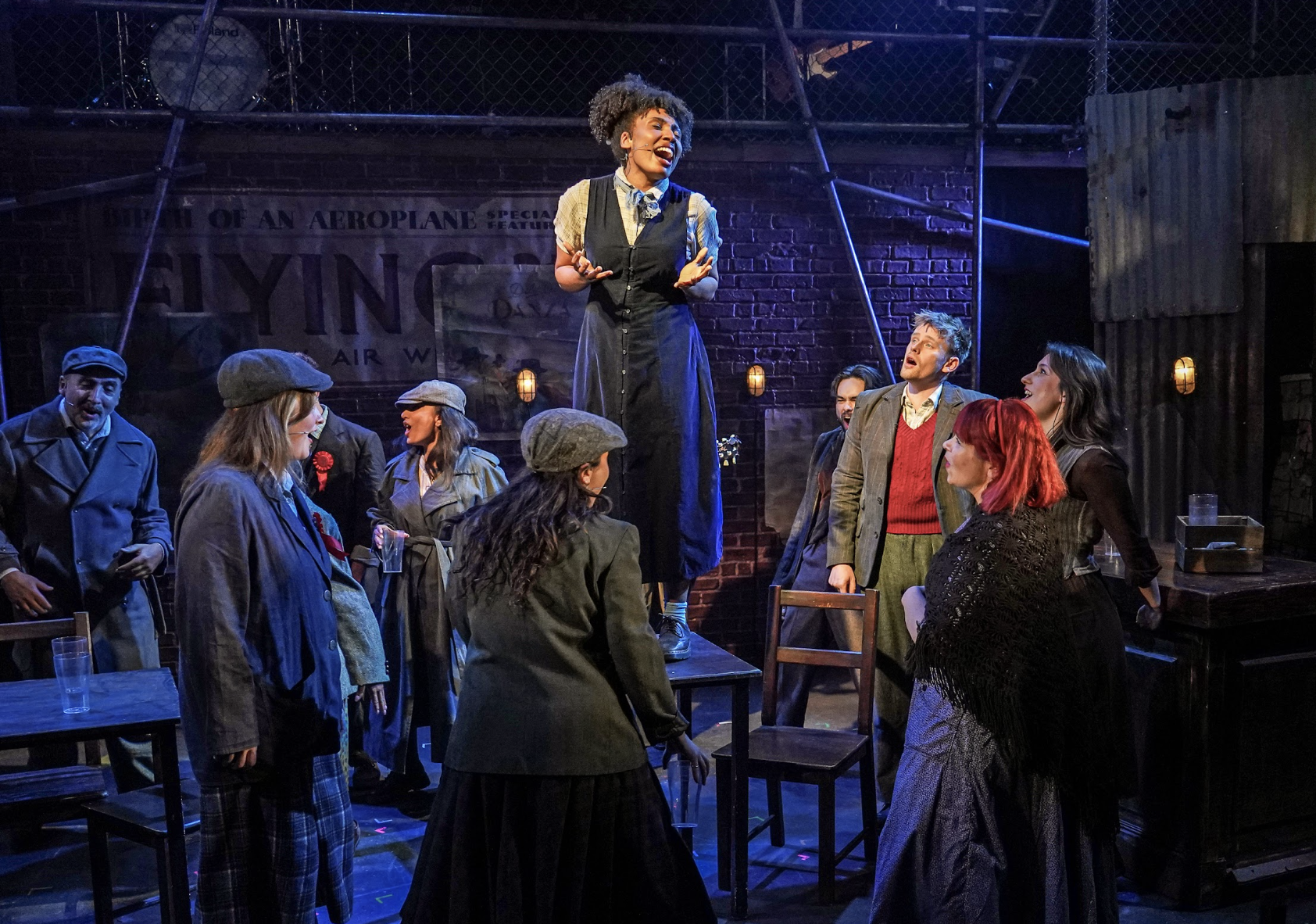
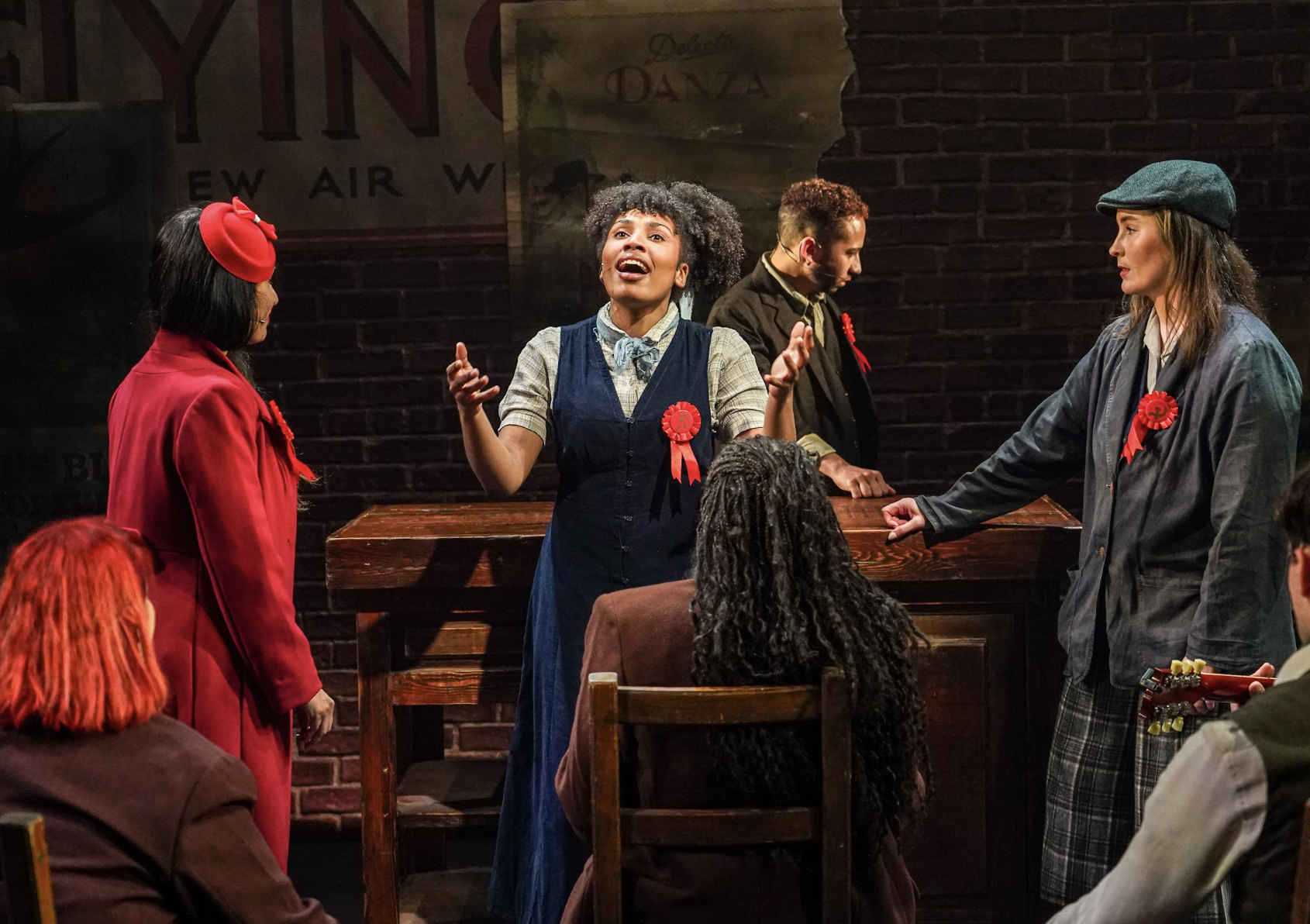
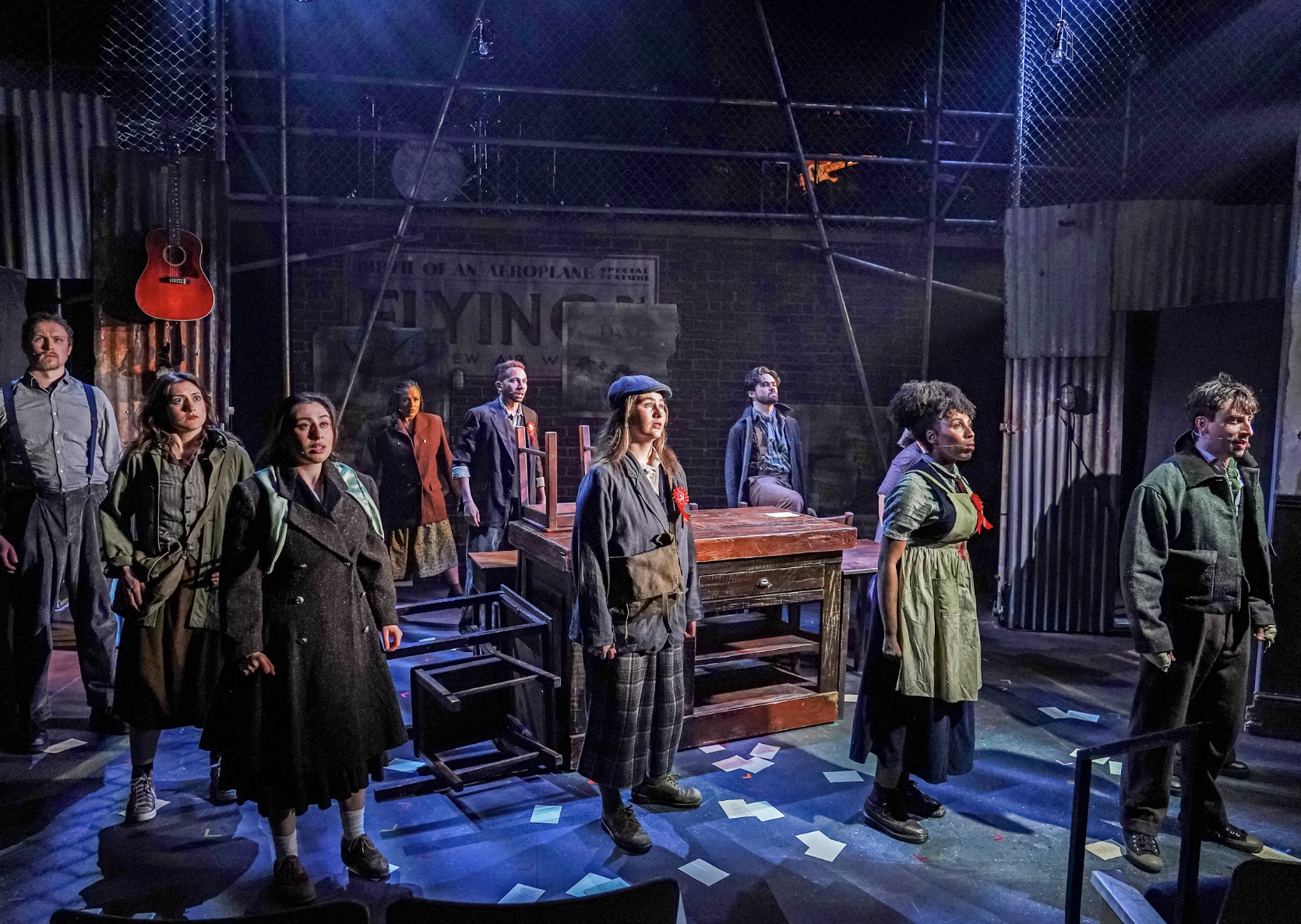
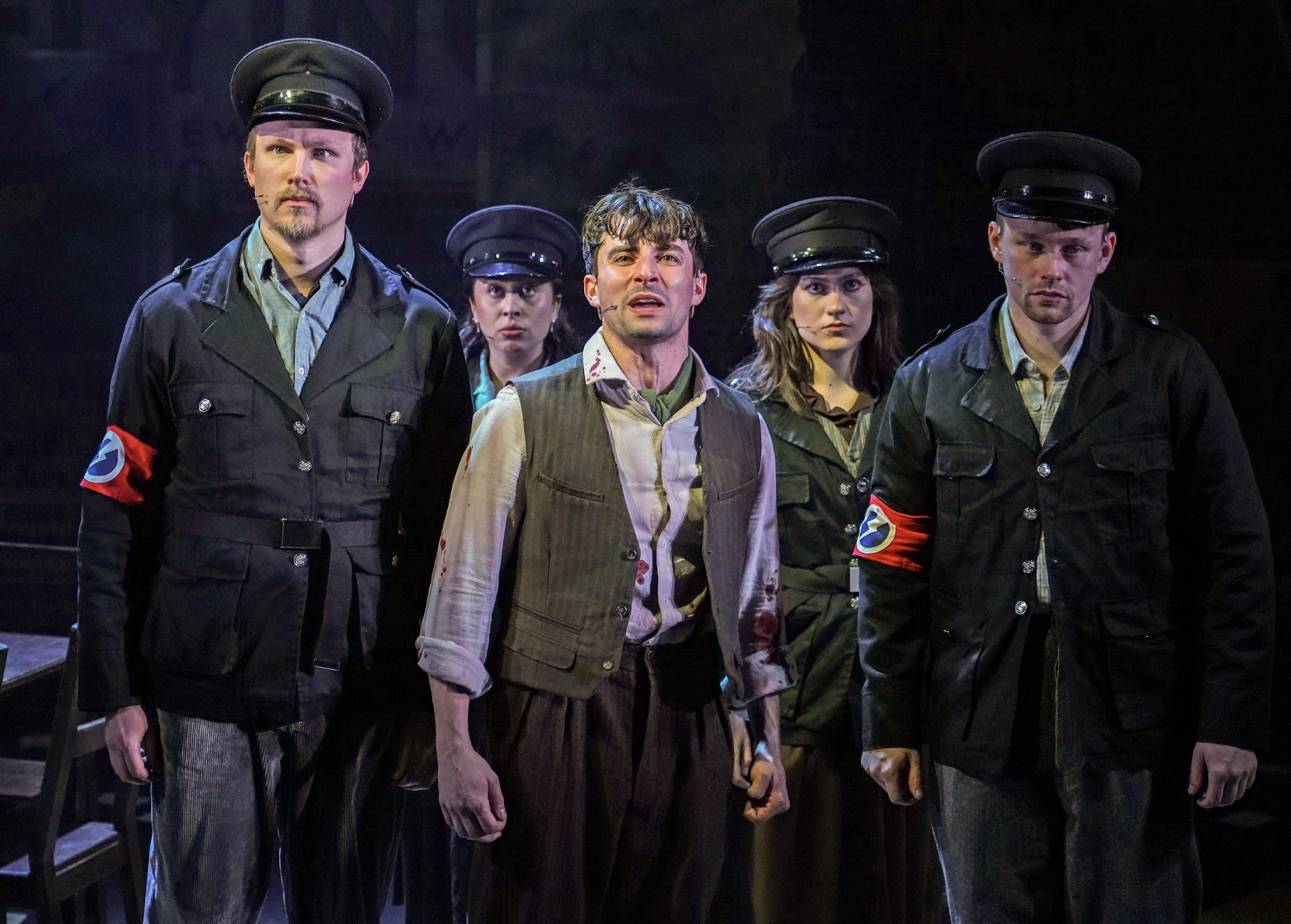
Photo credit by Carol Rosegg
There are musicals that flatter history into pageantry and musicals that exhume it like a warning siren. Cable Street, electrifying the stage at 59E59 Theaters, belongs emphatically to the latter category. This ferociously alive new work—conceived by book writer Alex Kanefsky and composer-lyricist Tim Gilvin, and staged with almost supernatural dexterity by director Adam Lenson—arrives not as a dutiful lesson from the past but as a historical reckoning unfolding in real time. Set against the 1936 Battle of Cable Street, in which working-class Jews, Irish immigrants, Communists, dockworkers, and neighborhood families united to block Oswald Mosley’s British Union of Fascists from marching through London’s East End, the production hums with the terrifying recognition that the machinery of division never truly disappears. It merely changes uniforms.
The achievement of the production begins with scale. On the compact stage of 59E59’s Theater A, a cast of thirteen incarnates an entire civilization in crisis: crowded tenements, dockyards, pubs, rallies, barricades, kitchens, newspapers, political meetings, and street battles all materialize with astonishing fluidity. Lesser productions would collapse beneath the sheer density of the material. Cable Street instead thrives on it. The staging possesses the muscular compression of a pressure cooker, as though history itself were being forced through a narrow artery. Lenson’s direction is not merely disciplined; it is symphonic. Bodies surge, collide, dissolve, and reform in patterns that evoke both civic chaos and collective choreography. The miracle is that amid the swirl, every emotional beat lands with startling clarity.
The musical frames its story through the contemporary East End, where Steve, a tour guide played with remarkable elasticity by Jez Unwin, introduces visitors to a neighborhood now marketed for its multicultural vibrancy while still shadowed by the ghosts of exploitation and xenophobia. Through the journals of his uncle Sammy Scheinberg, the play slips into 1936, where unemployment, rising rents, anti-Semitism, and nationalist fervor are transforming neighbor against neighbor. The device could have felt overly literary; instead, it becomes hauntingly permeable. Past and present bleed into one another until the audience can scarcely tell where memory ends and prophecy begins.
At the center of the drama are three young people whose intertwined trajectories become an anatomy of political seduction and resistance. Sammy, played by the sensational Isaac Gryn, is a Jewish boxer whose volcanic anger at economic humiliation makes him susceptible to despair as much as rebellion. Ron Williams, embodied with heartbreaking vulnerability by Barney Wilkinson, is an unemployed Englishman whose loneliness and wounded masculinity render him easy prey for fascist rhetoric promising belonging through exclusion. And then there is Mairead Kenny, magnificently portrayed by Lizzy-Rose Esin Kelly—an Irish poet employed in a Jewish bakery, fierce-eyed and spiritually unyielding, who becomes the production’s conscience without ever surrendering her humanity.
What distinguishes Cable Street from more schematic political musicals is its refusal to reduce ideology to abstraction. Fascism here does not emerge from cartoon villainy; it germinates in economic precarity, humiliation, loneliness, and fear. Ron’s gradual drift toward Mosley’s blackshirts is rendered with devastating precision. Wilkinson charts the character’s descent not as a sudden moral collapse but as a hunger to matter. When the fascists promise “British jobs for British people,” the slogan lands with a chilling familiarity. The musical understands, with unnerving intelligence, how authoritarian movements exploit alienation while disguising themselves as community.
Against this tide stands the fragile, furious possibility of solidarity. The Communist organizers who move through the neighborhood are not romanticized saints; they are flawed, argumentative, overextended people trying to forge common cause among communities conditioned to distrust one another. Yet the musical locates genuine transcendence in the act of collective resistance. Mairead’s insistence that “We’re all English now” arrives not as assimilationist sentiment but as an argument for shared struggle. Again and again, the score returns to the radical proposition that survival depends upon recognizing oneself in the stranger.
Gilvin’s score is among the most thrillingly eclectic written for the musical stage in recent years. Rock, folk, traditional musical-theater lyricism, agitprop chorales, rap, pub songs, and soaring ballads coexist in a restless musical vocabulary that mirrors the volatility of the East End itself. The influence of Hamilton, and even Evita flickers through the work without ever overwhelming its identity. Newspaper hawkers deliver biting satirical numbers while wearing placards announcing their papers’ political allegiances; choruses erupt into rhythmic, percussive movement; intimate confessions suddenly explode into collective anthem. Yet for all its stylistic range, the score remains emotionally coherent because every musical form emerges from character and circumstance.
The quieter songs cut deepest. “Only Words,” sung by Sammy’s father Yitzhak, becomes a trembling plea for restraint from a man who still believes civilization might yet recover its conscience. Unwin delivers the number with heartbreaking simplicity, his voice carrying the exhaustion of generations who have survived by endurance rather than confrontation. “Stranger/Sister,” meanwhile, unfolds as a luminous meditation on coexistence, its aching harmonies suggesting an alternate future perpetually on the brink of extinction. And when the mothers gather to sing “Happening Again,” the production achieves something close to tragic grandeur: history ceases to feel distant and instead presses against the walls of the theater like an approaching fire.
Gryn’s performance as Sammy is a star-making turn of astonishing dimensionality. He raps with razor-edged velocity, sings with bruised lyricism, fights with frightening physical conviction, and inhabits Sammy’s contradictions without smoothing any of them away. His rage at inherited caution—particularly in confrontations with his father—becomes one of the musical’s defining tensions. When Sammy erupts, insisting that the old words of patience are useless “while the world burns,” the line lands not merely as youthful rebellion but as a generational indictment. Gryn gives the production its dangerous pulse.
The supporting company is extraordinary across the board. Kelly’s Mairead radiates fierce intelligence and emotional authority, turning songs like “What Next?” and “The Wolf Is at the Door” into galvanizing calls for communal awakening. Wilkinson brings aching fragility to Ron, especially in the superb “Shut Me Out,” where the character’s craving for dignity curdles into susceptibility. Preeya Kalidas scorches the stage as the American journalist Elizabeth Warner in the incendiary “¡No Pasarán!” Ethan Pascal Peters delivers one of the production’s quiet marvels, carving two wholly distinct figures from the same theatrical fabric. As the fiery Jamaican Communist organizer, he radiates sharp intelligence and revolutionary conviction, his presence cutting through the tumult with galvanizing force. Yet as Sammy’s gentle brother, Peters softens into an altogether different emotional register, embodying tenderness and familial loyalty with heartbreaking restraint. The precision of his transformations speaks not only to his versatility but to the production’s larger achievement: the creation of an entire fractured community through the astonishing dexterity of its ensemble. Romona Lewis-Malley, Aoife MacNamara, Debbie Chazen, Natalie Elisha-Welsh, and Max Alexander-Taylor contribute performances of exceptional detail and generosity. Watching the actors transform roles with little more than a coat, a hat, or a change in posture becomes its own form of theatrical exhilaration.
Visually, the production achieves a kind of industrial poetry. Yoav Segal’s set—brick walls layered with tattered posters, corrugated metal, chain-link fencing, musicians elevated like workers trapped inside a mechanized apparatus—conjures a world simultaneously historical and disturbingly contemporary. Lu Herbert’s costumes elegantly collapse eras, contemporary outerwear peeling away to reveal period garments beneath, as though the past were always waiting directly underneath the present. Ben Jacobs and Sam Waddington’s lighting sculpts the stage into alleys, rallies, rooftops, and battlegrounds with cinematic urgency, while Charlie Smith’s sound design fills the theater with the restless sonic life of a neighborhood perpetually on edge.
And then comes the Battle itself. The barricades rise. Glass scatters across the streets. Mounted police surge forward. The ensemble hurls itself into the chaos with astonishing commitment, creating sequences of near-operatic intensity on a stage that should not physically be able to contain them. Yet the production’s greatest triumph is not spectacle. It is the moral clarity with which it understands collective action. Cable Street insists that fascism is defeated not through abstract ideals but through ordinary people deciding that the safety of one group cannot be separated from the safety of another.
By the time the musical reprises its opening anthem with a subtle but devastating shift in pronoun—from “my street” to “our street”—the effect is overwhelming. Cable Street emerges not simply as a history lesson but as a demand for historical memory itself. In an era once again intoxicated by xenophobia, authoritarian swagger, and the weaponization of economic despair, this magnificent musical arrives with the force of an alarm bell. It does not ask audiences merely to remember the past. It asks whether we intend to survive it repeating itself.
Click HERE for tickets.
Review by Tony Marinelli.
Published by Theatre Beyond Broadway on May 28, 2026. All rights reserved.
