
Juxtapose I A Theatrical Shadow Box
Presented by Happenstance Theater
Collaboratively Devised by Happenstance TheaterDirected by Mark Jaster and Sabrina Selma Mandell
With Gwen Grastorf, Mark Jaster, Sabrina Selma Mandell, Sarah Olmsted Thomas, and Alex Vernon
59E59 Theaters, Theater B, 59 East 59th Street, in Manhattan
January 7, 2026 - January 25, 2026
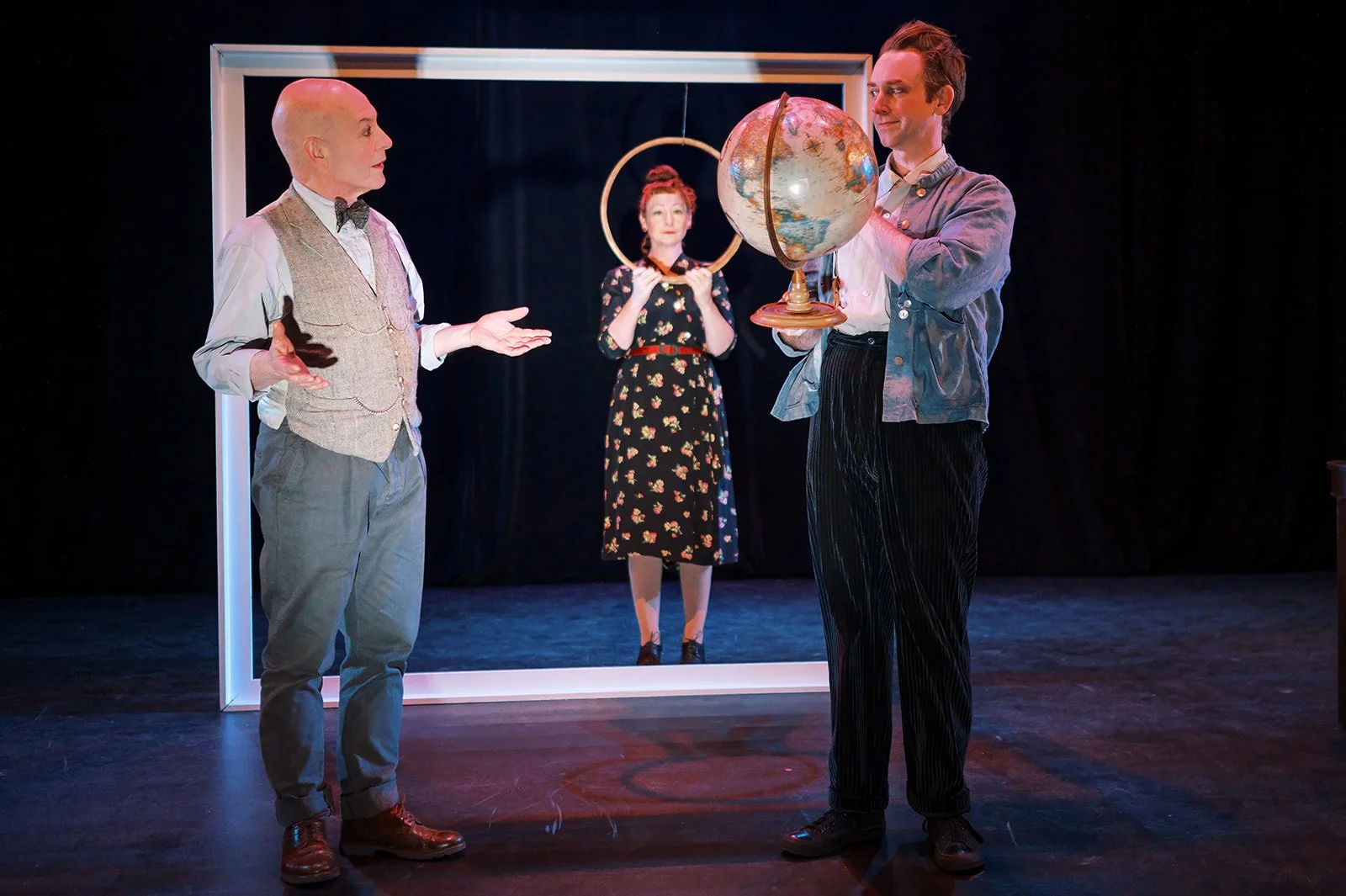
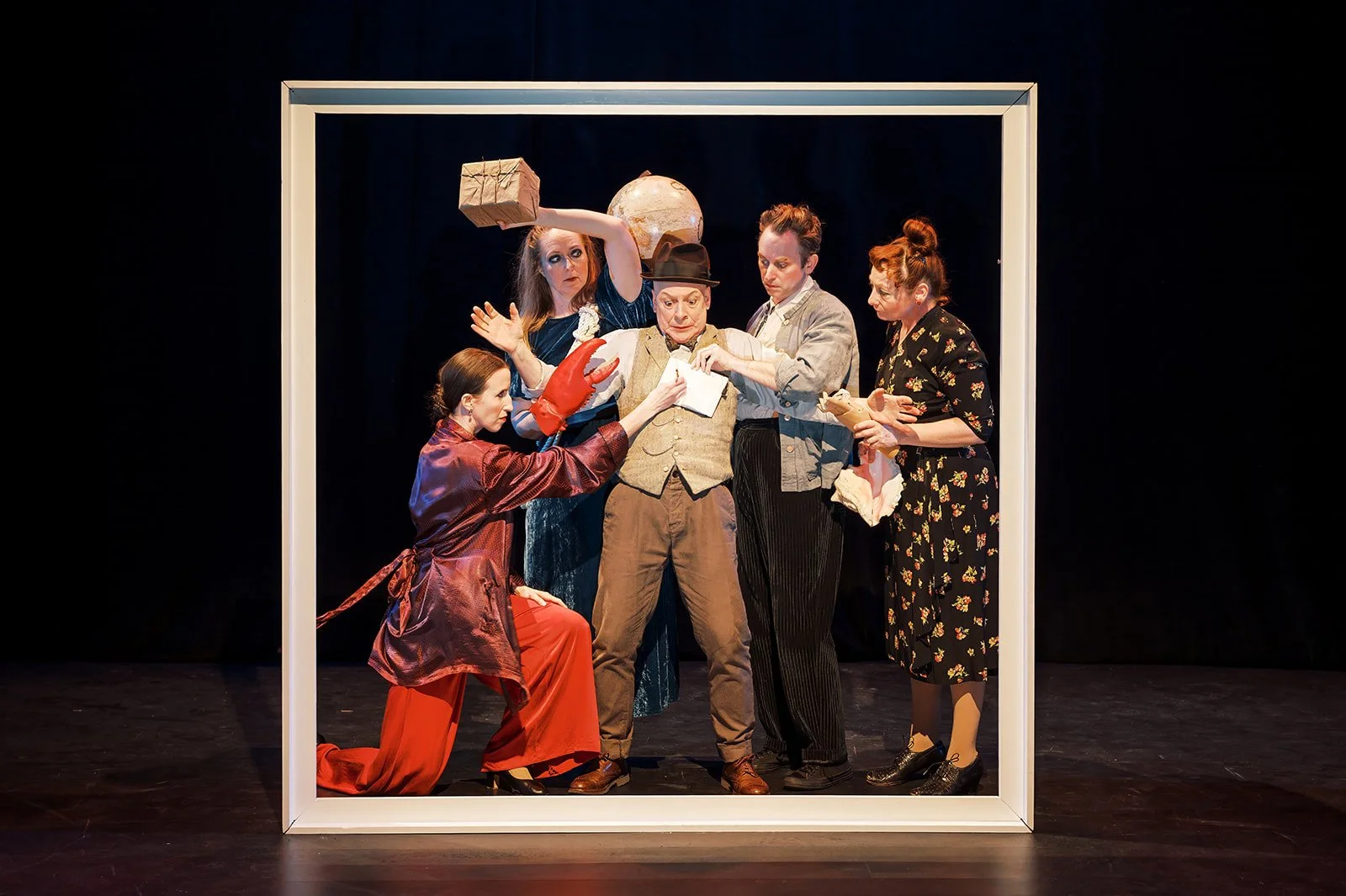
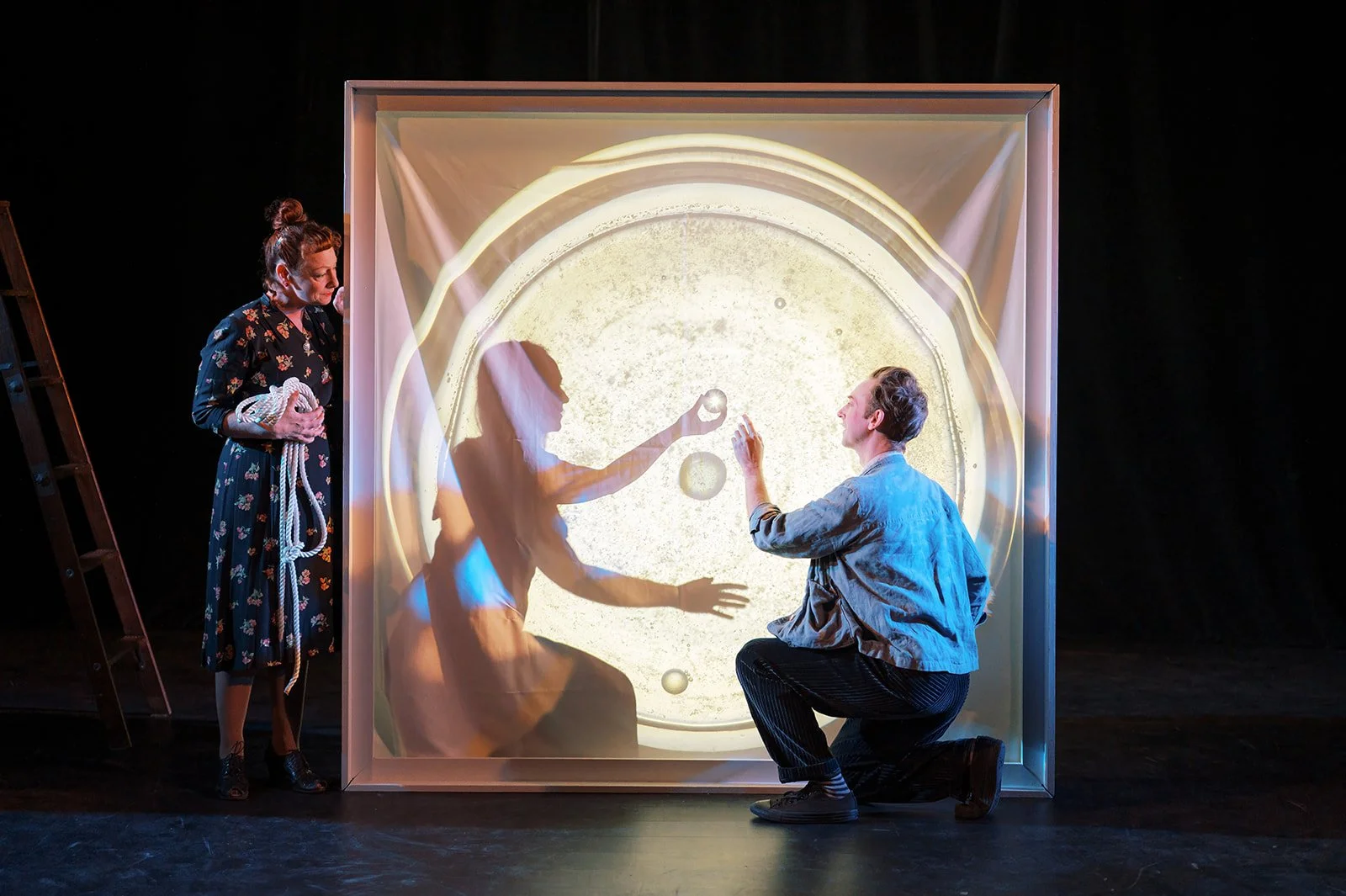
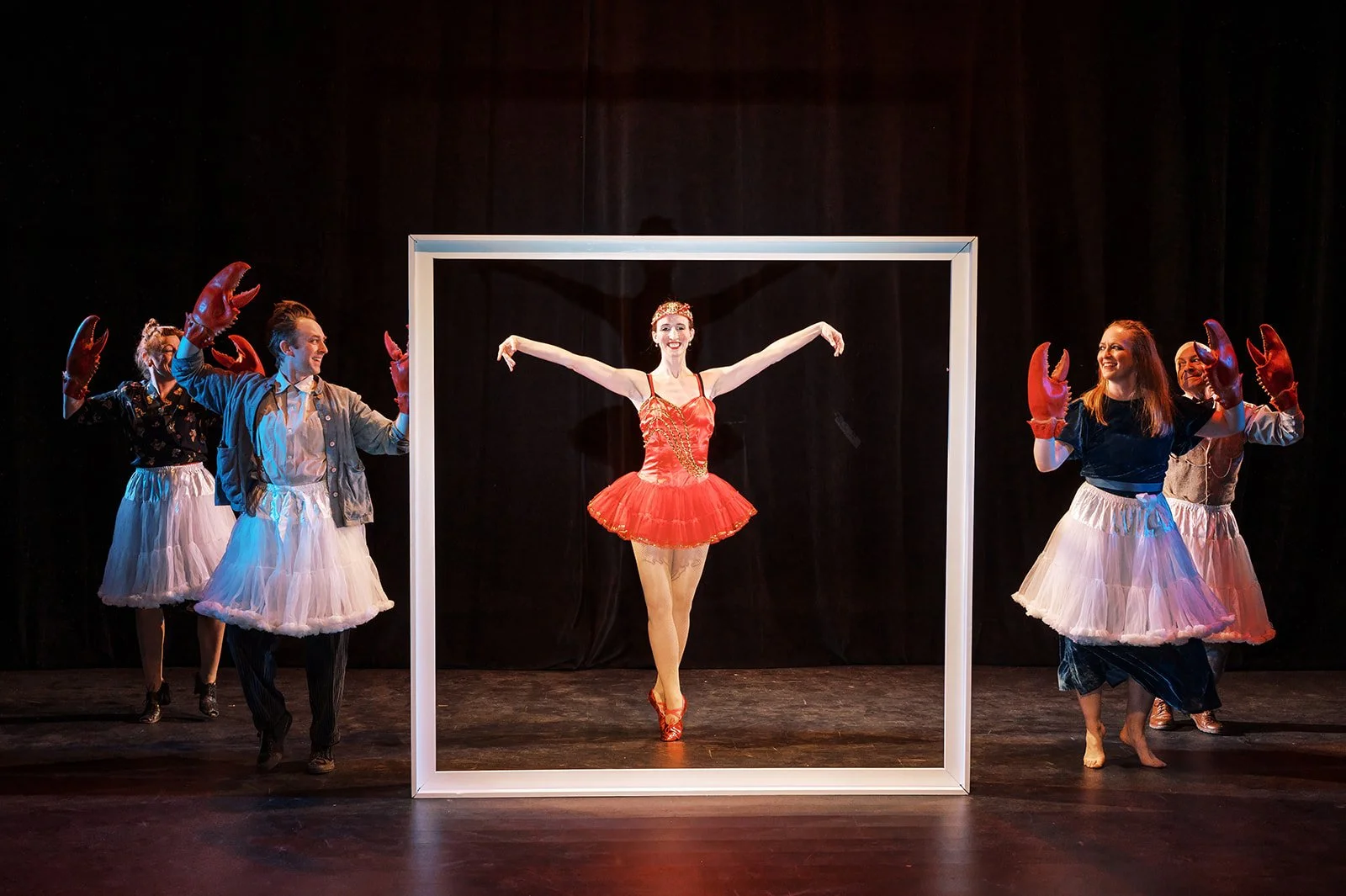
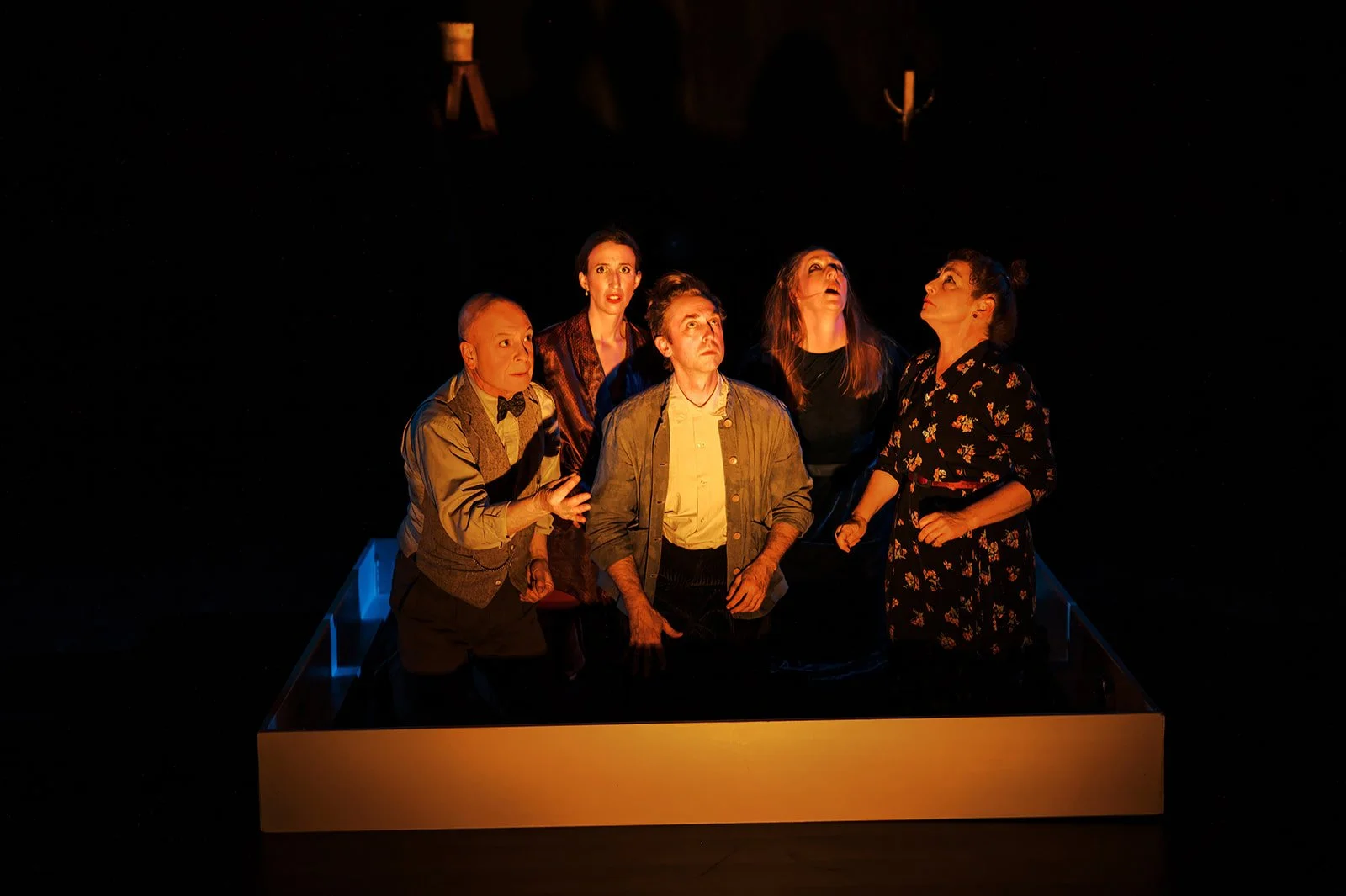
Photo Credit: Leah Huete
Juxtapose, the latest offering from the Washington, D.C.–based Happenstance Theater, arrives bearing the company’s familiar promise: a wordless—or nearly wordless—alchemy of mime, physical comedy, music, and visual invention, all in service of some guiding artistic obsession. Happenstance has a gift for turning these elements into something unexpectedly transporting, a kind of handcrafted theatrical clockwork that clicks into motion before your eyes. One need only recall Dreadful Episodes, seen at 59E59 last October, a mordantly funny valentine to the macabre whimsy of Edward Gorey, where suffocating Victorian decorum met with sudden, gleeful calamity. In that show, the company’s sensibility found its perfect match.
Juxtapose, first conceived in 2019 and now considerably elaborated, sets itself a more ambitious—and ultimately more diffuse—task. The piece began life as a tribute to both the assemblage art of Joseph Cornell and T. S. Eliot’s “The Love Song of J. Alfred Prufrock,” an unlikely pairing that already hints at the production’s restlessness. The Eliot connection, in performance, has become elusive. The Cornell influence, by contrast, is unmistakable and often quite lovely. Again and again, the stage resolves into images that seem to aspire to the condition of one of Cornell’s shadow boxes—miniature worlds in which longing, nostalgia, and eccentric order are held in delicate suspension. In these moments, Juxtapose frames the small sorrows and gentle absurdities of modern life as curated objects, arranged with care and an air of wistful curiosity.
Yet the program notes reveal just how far the piece has wandered from its original conceptual moorings. Over time, the script has expanded to encompass the cinematic sensibilities of Jean-Pierre Jeunet (Amélie) and Jacques Tati (Mon Oncle), along with ephemera, mass extinction and the Anthropocene, discovery, creation, play, attachment, and letting go. It is an admirably catholic list, but also a daunting one. With so many ideas vying for attention, the production rarely allows any single motif to deepen or resonate. Instead, images and gestures accumulate like artifacts in an overfilled cabinet of curiosities—pleasant to examine, but resistant to synthesis, yet somehow that is all okay.
The production’s most arresting passages are its “miniaturized” moments: small, carefully wrought theatrical tableaux that unfold with the intimacy of objects examined up close, as though glass. These poetic expositions, coupled with the characters’ halting attempts to connect across gulfs of mutual incomprehension, evoke a world in which art itself has come to substitute for a diminished humanity. People interact, collide, and occasionally brush against one another, yet rarely share a common tongue. Understanding, when it arrives at all, is partial, provisional, and fragile. Language, in the conventional sense, is largely absent from the piece. In its place are the grammars of mime, the idiosyncratic pseudo-language spoken—or chirped—by a bird-like figure, and episodes of dance that operate as speech acts, conveying intention, longing, and resistance through the body rather than the mouth. Meaning here is not delivered but inferred, assembled by the audience from gesture, rhythm, and repetition. It is theatre that asks you not so much to listen as to watch, and to feel your way forward.
The resulting world is fluid—almost aquatic in its logic—where scenes seem to drift into one another, buoyed by an internal tide rather than by narrative causality. There is something beautifully surreal in this environment, a sense of being suspended inside a dream whose rules are felt rather than explained. What ultimately emerges is a deeply sensory meditation on loneliness: its quiet ache, its isolating distortions, its strange beauty. And yet, punctuating this solitude are glimmers of hope—small, luminous moments of connection that suggest that even in a landscape where language has failed, the impulse toward communion stubbornly survives.
At the center of the piece is a loose but suggestive narrative, one that gathers five figures as disparate as curios salvaged from different worlds and asks them to co-survive within what might best be described as a magical-realist tenement building. This shared dwelling—at once refuge and pressure cooker—exists under the shadow of an apparent End of Days, an apocalypse that is never fully specified but always keenly felt. The threat feels both mythic and unnervingly contemporary, as though catastrophe were less an event than a condition of living together. Visually and aurally, the production gestures toward the early twentieth century: the costumes recall a bygone era of vaudeville, silent cinema, and hand-cranked dreams, while the music hums with a similarly antique melancholy. Yet the urgency that propels these characters is resolutely unmoored from period. It could belong to any century in which people have sensed the ground shifting beneath them—including our own.
The inhabitants of this crumbling cosmos are sharply etched types, each carrying their own private mythology. Spilleth (Gwen Grastorf) is perhaps the most striking: an avian, mermaid-adjacent creature who quite literally drops in from above, as if delivered by fate or gravity or both. She leaves a hole in the ceiling in her wake. Ètoile (Sarah Olmstead Thomas), a would-be dancer, moves through the world with the visible aftershocks of childhood trauma, her body bearing the memory of a drill-sergeant-turned-ballet-teacher whose discipline crossed into cruelty. Blue (Alex Vernon) is a figure of pure echo; he never speaks in an original voice, only mimicking the sounds and words of those around him, all the while clutching—or orbiting—a blue rubber ball that seems less a prop than a floating extension of his inner life. With his benign, open smile and a Stan Laurel–like tuft of hair that seems perpetually on the verge of mischief, Vernon proves quietly beguiling in one of the production’s most tender images. Slipping his arm into the empty sleeve of a hanging dress, he stages an entire courtship in silence, partnering himself with an absence. The gesture is at once comic and achingly lonely: a private fantasia of intimacy performed for no one and everyone at once. In this brief, wordless sequence, Vernon demonstrates how little is required to suggest a life of longing—only a sleeve, a body, and the willingness to believe, if only for a moment, in the presence of someone who is not there.
Then there is The Collector (Mark Jaster), a man defined entirely by his accumulations. He gathers small things, odd trinkets, and discarded objects, each one a quiet marker of time’s passage, as though by cataloguing the detritus of living he might hold entropy at bay. On his person there are always not one, but three pocket watches…which probably says volumes about his trust issues. Presiding over them all is Rosabelle (Sabrina Selma Mandell), who runs the building—and, by extension, this fragile community—with a hand that is both firm and gently maternal, embodying the tenuous authority of care in a collapsing world.
Around these figures swirls a profusion of visual invention: larger-than-life lobster claws (which later turn into an odd bouquet), a giant kaleidoscope, and a host of images that feel plucked from a shared dream. It is spectacularly magical theatre, but its magic is edged with menace. Beneath the whimsy lies an ideologically dark and foreboding vision, one that suggests that even the most playful acts of imagination may be haunted by the knowledge that the world, as we know it, is always on the brink of coming apart.
One of the production’s most striking and quietly insistent images is the permanent presence of an enormous shadow box, looming over the stage like an architectural thought experiment. At times it quite literally frames the action, compressing the events of the play into a miniature, curated world and inviting the audience to regard the characters as specimens, keepsakes, or fragile figurines caught in a display case. The effect is more than aesthetic. It places the drama at a remove, shrinking it just enough to make its sorrows and absurdities legible. The cloistered inhabitants of the boarding house in Juxtapose enact a similar tension in their inner lives: a restless push and pull between the safety of enclosure and the unknowable, possibly catastrophic world that waits beyond their doors.
Directed by Sabrina Mandell and Mark Jaster—two artists whose creative fingerprints are unmistakably all over the piece—the production is defined by its fluidity and its evanescence. Scenes bleed into one another; ideas appear, dissolve, and reconstitute themselves in altered form. Dance and motion are not decorative here but structural. Movement is the grammar through which this world speaks, and the performers execute it with a deceptive ease that belies the precision required. What looks spontaneous is, in fact, exquisitely chorographed.
Within this kinetic ecosystem, individual performances register as distinct tonal notes. As Ètoile, Sarah Olmstead Thomas leans fully into the character’s neurotic edge, her physicality sharp and nervously comic. She supplies a much-needed breath of levity, puncturing the prevailing heaviness of this postmodern landscape with humor that feels earned rather than imposed. Gwen Grastorf’s Spilleth, by contrast, is a kind of airborne koan: a largely serene, almost meditative presence, interrupted by sudden flares of birdcall hysteria that heighten the production’s sense of magical realism. The character seems to hover just outside ordinary logic, and Grastorf inhabits that liminal space with assurance.
Alex Vernon, as Blue, demonstrates how eloquent silence can be. His refusal of speech becomes a form of expressive restraint, and his sleights of hand—precise, playful, and faintly mysterious—are among the production’s most quietly mesmerizing elements. Mark Jaster’s Collector, true to his ominous title, brings an undercurrent of creepiness to the stage, though it is a creepiness tempered by philosophical curiosity rather than menace alone. He is less a villain than a walking meditation on accumulation and loss. And at the center of it all stands Mandell’s Rosabelle, a charmingly anachronistic figure who recalls a bygone theatrical era. She functions as the glue of this fractured community, though the production is clear-eyed about the limits of her power: try as she might, she cannot hold everything together—not in this space, and not in this particular moment of the world.
Mandell herself designed the costumes, which strike a delicate balance between period evocation and fantastical invention, as though garments from an early-twentieth-century attic had been reassembled according to the logic of a dream. The props and scenery, devised collaboratively by Mandell, Jaster, and Vernon, extend this aesthetic into three dimensions, creating a tactile world of objects that seem to carry both history and private significance. Every trunk, trinket, and piece of furniture appears to have lived a prior life, lending the stage a patina of memory and melancholy. The lighting, by Daniel Weissglass and Kris Thompson, is assured and unobtrusive, sculpting space with a steady hand and allowing the production’s many visual ideas to emerge with clarity rather than clutter. Their work quietly guides the eye, alternately isolating and unifying the performers, and providing the necessary atmospheric shifts without ever calling undue attention to itself.
Most evocative of all is Madeline Oslejsek’s sound design, a richly layered tapestry that braids environmental effects—surf breaking in the distance, the flutter of birdsong, the echo of children at play—with exquisitely rendered period melodies. Snatches of tunes like “Charleston” and “Stardust” drift through the space like half-remembered reveries, anchoring the production in a bygone emotional register while also underscoring its themes of nostalgia, loss, and yearning. The result is an aural landscape that does not merely accompany the action but deepens and complicates it, enveloping the audience in a world that feels at once intimate, uncanny, and poignantly out of time.
The production, guided by an ultra-creative directorial vision, distinguishes itself as something genuinely singular, defined by a sense of fluidity and evanescence that resists easy categorization. Scenes seem to emerge, dissolve, and reconfigure themselves as though subject to an internal tide, leaving behind impressions rather than fixed meanings. It is theatre that feels perpetually in motion, more like a living organism than a finished object, its fleeting beauty residing precisely in its refusal to remain still.
Click HERE for tickets.
Review by Tony Marinelli.
Published by Theatre Beyond Broadway on January 31th, 2026. All rights reserved.
