
Oklahoma Samovar
Written by Alice Eve Cohen; Directed by Eric Nightengale
The Downstairs Theatre at La MaMa Experimental Theatre Club | 66 East 4th Street, New York 10003
December 5 - December 21, 2025
Photo Credit: Marina Levitskaya-Khaldey
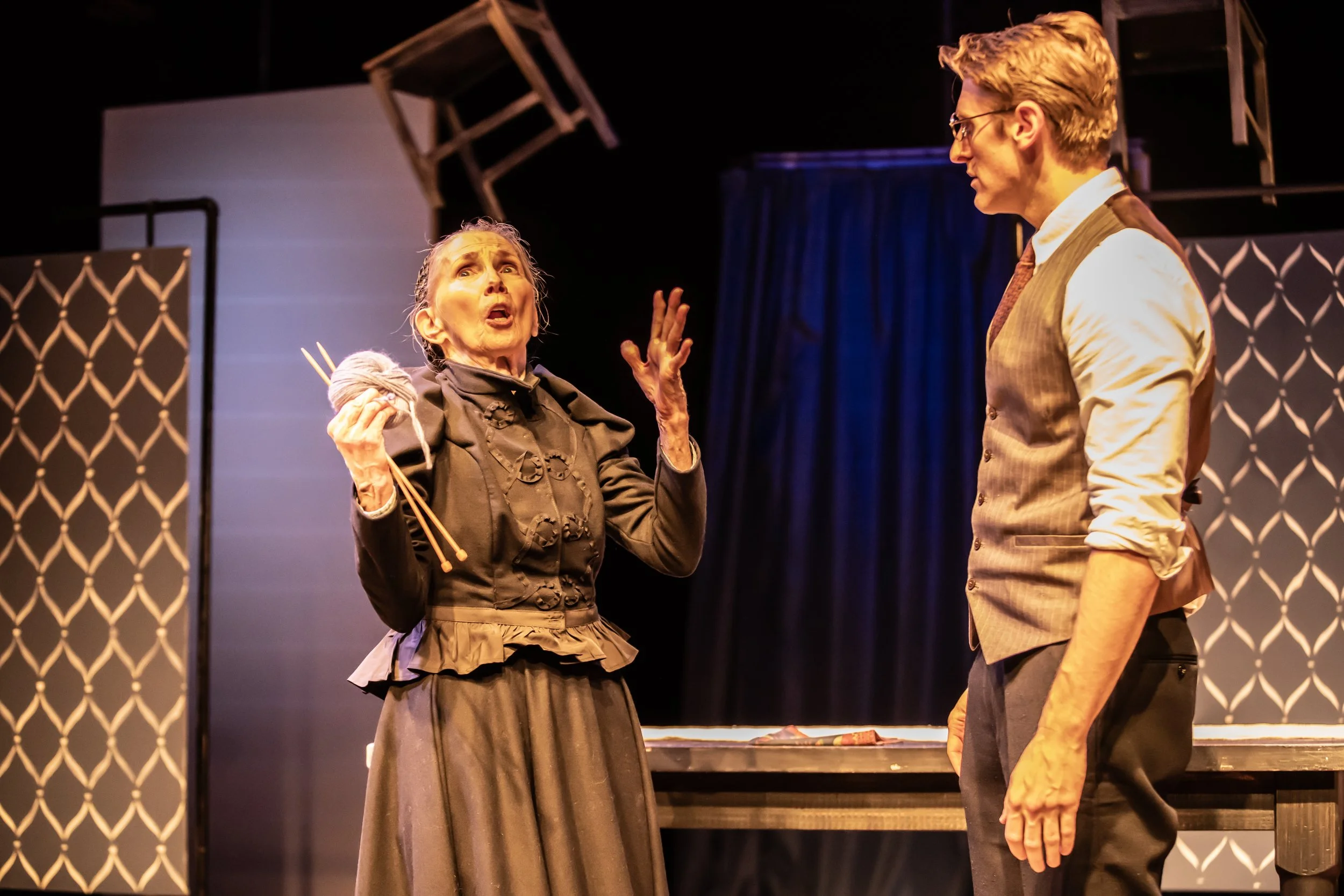
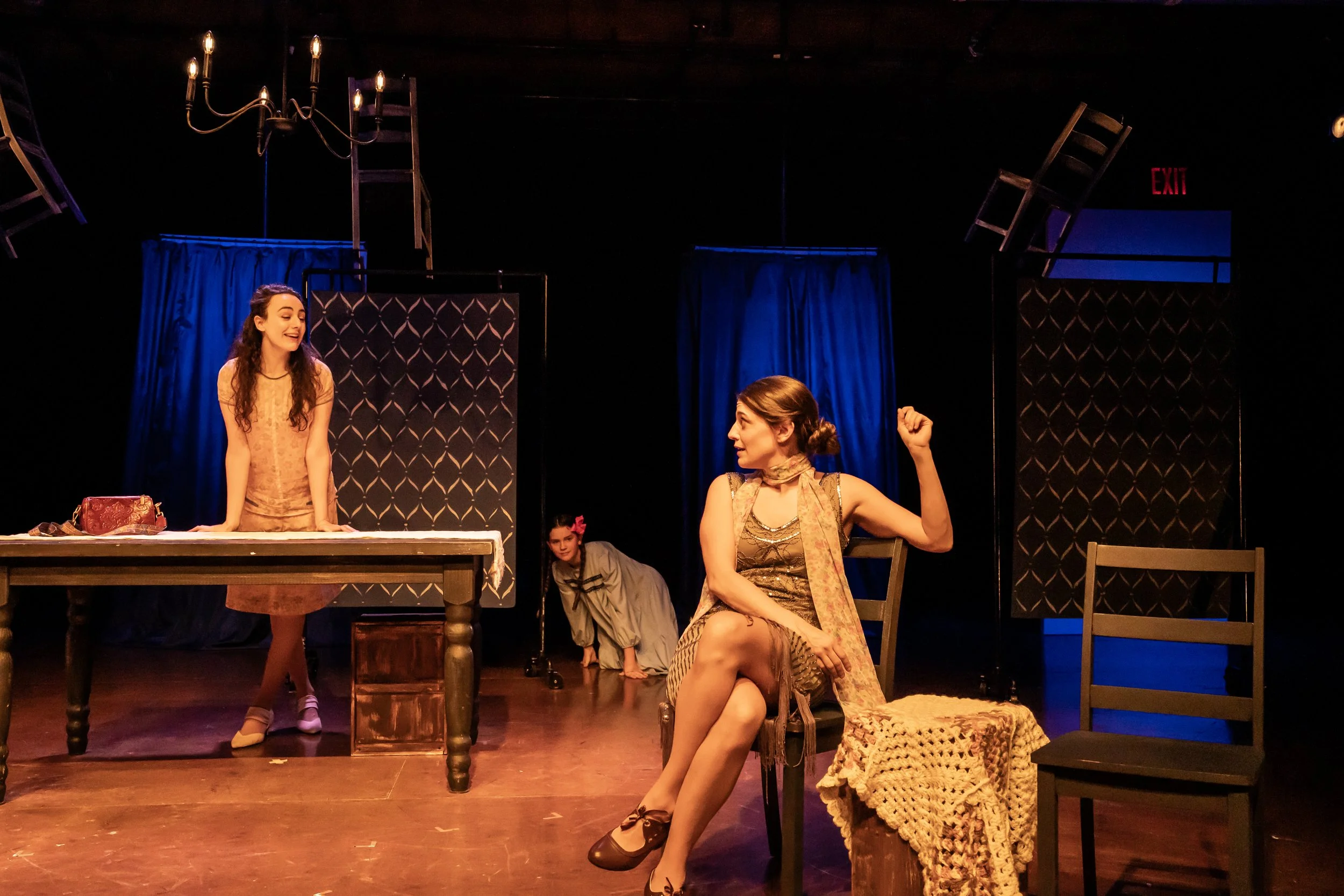


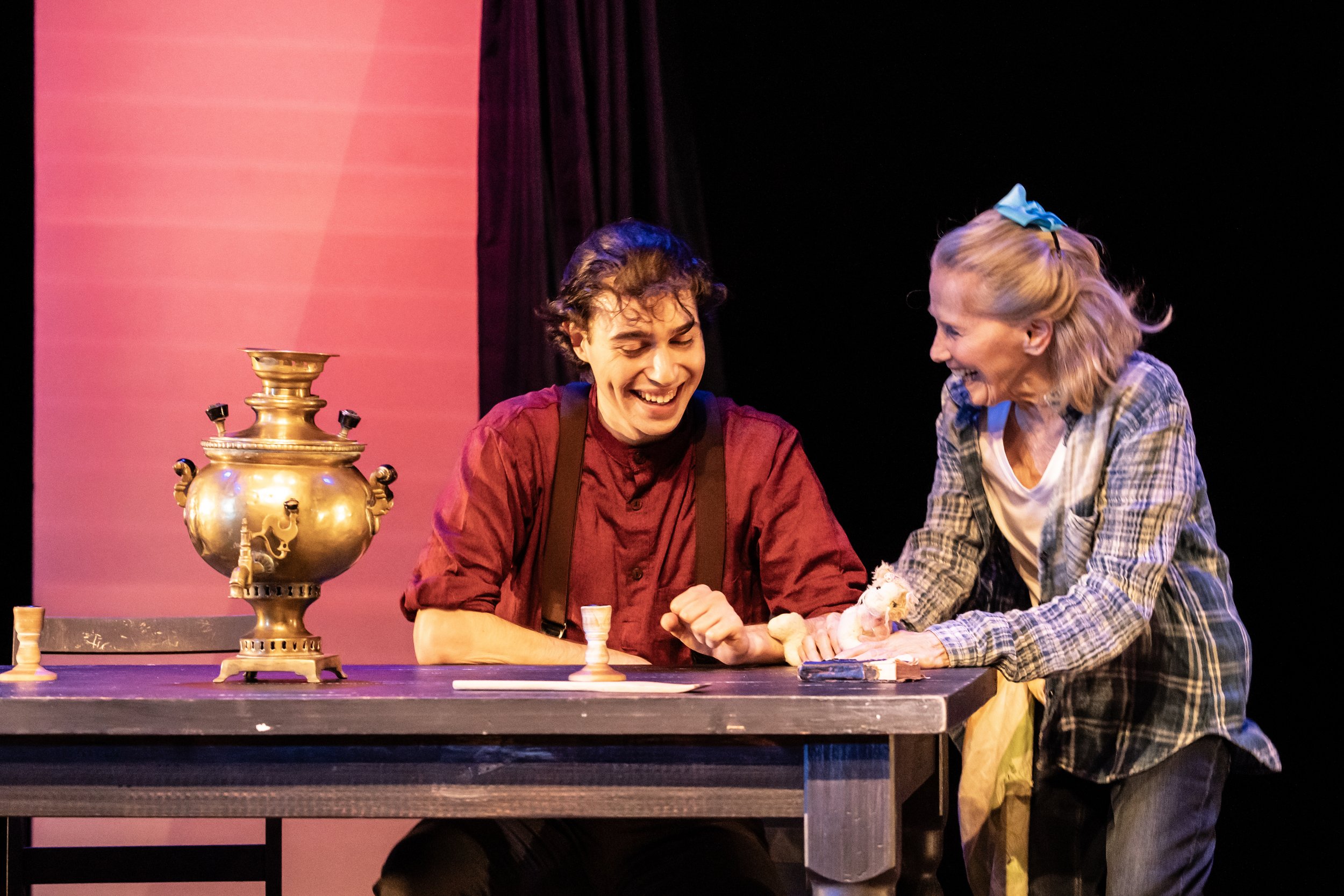


In Oklahoma Samovar, Alice Eve Cohen undertakes an act of theatrical reclamation, rescuing from the margins of American myth a story that has too often gone unspoken: the Jewish encounter with the frontier. What emerges is not merely a family chronicle but a meditation on belonging, ritual, and cultural persistence—one that quietly insists that Jewish history in America did not unfold only along the crowded sidewalks of the Lower East Side, but also across windswept plains where there were no synagogues, no kosher butchers, and no one, as one character memorably observes, who even knew what a Jew was.
The play begins, fittingly, with displacement. Jake Meyer, a Jew from Latvia fleeing conscription into the Russian Army, arrives in America by way of New York before drifting—almost improbably—into Oklahoma, where he and his bride Hattie find themselves the only Jews for miles around. Their predicament raises questions that reverberate through the entire evening: How does one keep faith without community? How does ritual survive when its social scaffolding has disappeared? These questions are posed not polemically but tenderly, through domestic detail and lived experience, giving the play its quiet moral force.
Cohen frames her century-spanning narrative as a mystery, opening in 1987 with Emily, a 21-year-old New York college student, played with searching openness by Nadia Diamond, arriving at her great-aunt Sylvia’s farmhouse (Sylvia embodied by Joyce Cohen with a weathered, luminous authority). They are in Chandler, Oklahoma, with Emily clutching her mother’s funeral urn. The device is an inspired one. Emily’s journey—prompted by a letter requesting that ashes be scattered on land she has never heard of—becomes the audience’s invitation to move backward through time, uncovering the buried logic of inheritance, memory, and silence. From its opening moments, Oklahoma Samovar announces its ambitions with a simplicity that is quietly arresting. It is an image of hushed gravity, one that immediately situates the audience in a world where the past is not abstract but palpably present, waiting to be acknowledged. What might initially seem narratively transparent soon reveals itself as thematically rich: the mystery is not who Sylvia is, or why Oklahoma matters, but how histories fracture, go unspoken, and must sometimes be reassembled by the next generation.
Director Eric Nightingale is buoyed by an exquisite cohort of designers whose collective work does more than embellish the production; it articulates its very grammar. Foremost is Nightingale’s own immersive sound design, a meticulously sculpted aural landscape that operates as both atmosphere and argument, guiding the audience’s emotional and intellectual attention with an almost novelistic precision. The sound does not merely underscore the action—it thinks alongside it, shaping time, memory, and interiority in ways the spoken word alone cannot.
Anna Kiraly’s set and puppet design extends this sensibility into the visual realm, offering an environment that feels at once handcrafted and metaphysical. Her designs suggest a world perpetually in the act of becoming, where objects carry histories and puppets assume the quiet authority of memory made flesh. Barbara Erin Delo’s costumes, finely attuned to character and period without ever lapsing into illustration, provide a tactile intimacy that grounds the production’s more abstract impulses. Federico Restrepo’s lighting, meanwhile, completes the alchemy, carving space and emotion with painterly restraint. Together, these designers do not merely realize Nightingale’s and Cohen’s vision—they give it texture, temperature, and breath, rendering the production a fully integrated work of theatrical thought.
Nightengale stages the play with an economy that recalls story theater at its most effective. The approach suits Cohen’s writing, which privileges anecdote, texture, and moral inquiry over spectacle. If the production’s means are modest, its ambitions are anything but. One of the most quietly astonishing achievements of Oklahoma Samovar is the virtuosity of its six-person ensemble, whose collective ability to pivot—psychologically, physically, and morally—across a full century of lived experience recalls the great traditions of repertory acting more than the naturalism that dominates so much contemporary American theater. These are not merely quick costume changes or vocal tricks, but acts of sustained imaginative embodiment, in which age, temperament, and historical circumstance are rendered legible through posture, rhythm, and a finely calibrated sense of inner life.
At the center of this feat is Nadia Diamond, whose performance might be described as a study in generational permeability. She plays Emily, the young woman who arrives in Oklahoma bearing her mother’s ashes, with an alert, unguarded modernity; yet she also inhabits Rose, from a restless 18-year-old to a woman approaching 50, with a gravity that feels earned rather than imposed. Diamond makes palpable the continuity between these two women separated by decades—how the questions Emily carries unknowingly echo the unresolved tensions of Rose’s life as daughter of frontier settlers Jake and Hattie and mother to Clara. Her transformations unfold in full view of the audience, and they never feel like tricks; they feel like time itself passing through a single body.
If Diamond supplies the connective tissue, Joyce Cohen provides the play’s anchoring weight. Her Sylvia, encountered at age 87, is a figure of accumulated knowledge, sturdy and unsentimental, shaped by endurance rather than nostalgia. Yet Cohen’s range is almost preternatural: she also appears as Sylvia at ages 4, 14, and 45, each incarnation sharply etched and emotionally distinct. To this she adds Hattie’s mother, at both 42 and 97, giving us a life compressed into two moments of departure and reckoning; Charlie McClanahan, the Kansas banker whose bafflement provides a note of frontier comedy; and Mrs. Giventer, the suffocating, disapproving matriarch whose presence haunts Rose’s married life. In lesser hands, such multiplicity might feel schematic. Cohen’s performances instead accrue meaning through contrast, demonstrating how authority, fear, and love mutate across time and social role.
Sarah Chalfie brings a luminous steadiness to Hattie, charting her journey from a 17-year-old bride arriving with samovar and feather bed in tow to a 75-year-old woman shaped by endurance, compromise, and hard-won clarity. Chalfie’s Hattie is never reduced to a symbol of pioneer fortitude; she remains recognizably human at every stage, capable of humor, terror, tenderness, and resolve. Chalfie’s Hattie charts a moving trajectory from shock to adaptation, her initial horror at the realities of prairie life giving way to a hard-earned, clear-eyed strength. Chalfie also plays Maxine, Rose’s confidante and sister-in-law, with an ease that underscores the social texture of the play’s middle generation, offering a glimpse of intimacy and solidarity within the constraints of family and expectation.
Sahar Lev-Shomer’s Jake is quietly resolute, a man whose pragmatism is tempered by an unspoken longing for the life he has left behind. He carries the first half of Oklahoma Samovar on his shoulders with a restraint that is all the more affecting for its lack of display. Playing Jake from ages 18 to 56, Lev-Shomer charts a life defined by motion: the perilous departure from Latvia, the disorienting arrival in New York, the provisional hope of Kansas, and the hard, defining settlement in Oklahoma. His Jake is not a romanticized pioneer but a man whose endurance is forged out of necessity, whose pragmatism coexists with a stubborn, unarticulated longing for continuity. Lev-Shomer allows us to feel the cumulative cost of exile—not in speeches, but in the way his body seems to settle, scene by scene, into the land it must finally claim. His interactions, like those of Chalfie as Hattie, with the non-Jewish locals—bemused, curious, occasionally bewildered—are played with warmth and gentle irony, underscoring the play’s central paradox: isolation can sometimes breed tolerance, even as it deepens loneliness. The emotional and intellectual core of the play lies in its earliest chapters, with Jake and Hattie’s arrival on the plains. These scenes are suffused with a sense of wonder and estrangement, made vivid through inspired concrete symbols—most notably Hattie’s enormous samovar, lugged across continents at her mother’s insistence. The samovar, elegant and impractical amid the dust and cow-chip fuel of frontier life, becomes a portable hearth, a gleaming emblem of continuity amid rupture. In these moments, Cohen achieves something rare: she renders history intimate without sentimentalizing it, allowing humor and hardship to coexist naturally.
Alex J. Gould offers a study in contrast and adaptability. As Ben, whom we meet at age 22 on the beaches of Coney Island and follow through middle age, Gould captures the intoxicating charm of youthful intellectual ardor—the poetry, the literary quotation, the easy romantic confidence—that initially draws Rose into his orbit. As the years pass, Gould subtly recalibrates the performance, allowing Ben’s charm to curdle into dependency and emotional inertia, without ever tipping into caricature. That same actor also appears as the Sooner who illegally enters the Oklahoma Land Run before its official start, as well as Max, the man who befriends Jake on the frontier. In these roles, Gould supplies a crucial sense of the world beyond the family: opportunistic, companionable, ethically ambiguous. Each appearance refracts a different version of American masculinity, set against Jake’s quieter moral seriousness.
Seren Kaiser, in the roles of Little Rose (age 8) and Little Clara (age 7), contributes something rare and essential: a genuine sense of interior life in childhood. These performances are not decorative or merely symbolic; they ground the play’s generational sweep in lived experience. Kaiser brings a stillness and attentiveness to both children that suggests futures already under formation, even as innocence remains intact. Through her work, the audience glimpses how patterns—of silence, of resilience, of longing—are absorbed long before they are understood.
As the play advances through subsequent generations, Cohen broadens her canvas to explore assimilation, conflict, and the ways Jewish identity shifts under social pressure. The Brooklyn episode involving Rose and her ill-fated marriage offers a counterpoint to the frontier scenes, exchanging physical isolation for emotional suffocation. Here, the play probes the costs of communal expectation and inherited piety, suggesting that belonging, too, can become a form of exile.
What ultimately distinguishes Oklahoma Samovar is not its plot mechanics but its ethical curiosity. Cohen is less interested in resolving every narrative thread than in honoring the act of remembrance itself. The play understands history as something unevenly transmitted: fragments overheard, objects preserved, letters discovered too late. In this sense, its episodic structure feels less like a flaw than a reflection of its subject. Lives are not remembered evenly; some blaze brightly, others flicker at the edge of consciousness. It is the precision and generosity of this cast that allows the play’s century-long journey to feel not only intelligible, but deeply, movingly human. The result is a rare theatrical experience: one in which the audience is invited to witness not only a family’s evolution, but the extraordinary capacity of actors, through disciplined imagination, to make history breathe.
In the final accounting, Oklahoma Samovar stands as a generous and necessary addition to the growing body of American Jewish drama that seeks to complicate inherited narratives. Like Tom Stoppard’s Leopoldstadt, it asks what it means to carry a people’s story forward—but it does so from an unexpected vantage point, where tea is brewed on a samovar in the middle of nowhere, and faith survives not through institutions, but through stubborn, quotidian acts of care. Cohen’s play may be intimate in scale, but its vision is expansive, reminding us that the American story, like the Jewish one, has always been larger—and stranger—than we imagine.
Click HERE for tickets.
Review by Tony Marinelli.
Published by Theatre Beyond Broadway on December 16, 2025. All rights reserved.