
SARDINES
Presented by New York Theatre Workshop as part of In The Bricks Festival
Written & Performed by Chris Grace, Directed by Eric Michaud
New York Theatre Workshop’s Fourth Street Theatre, 83 East 4th Street, in Manhattan
May 6, 2026 - June 14, 2026
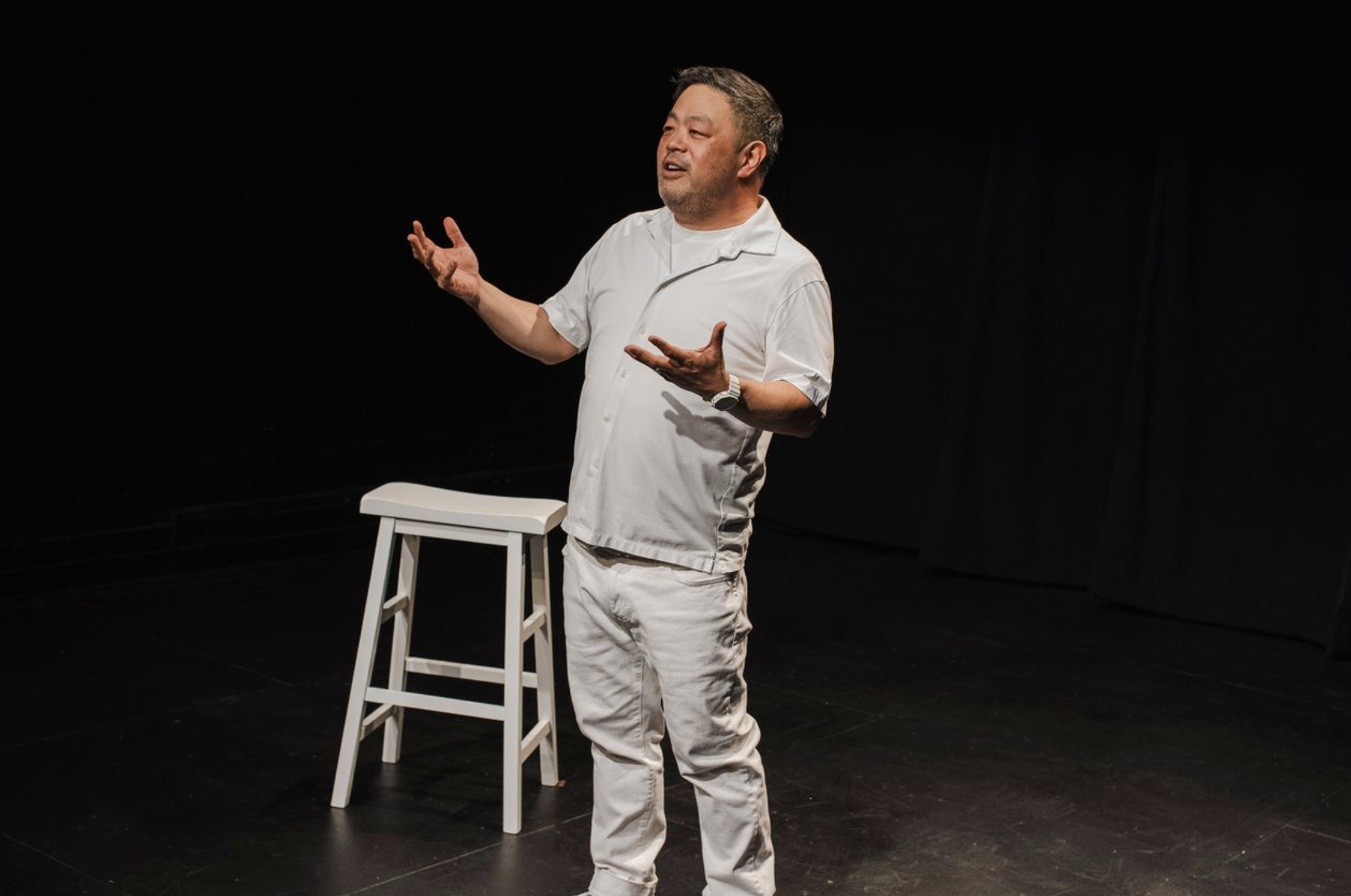
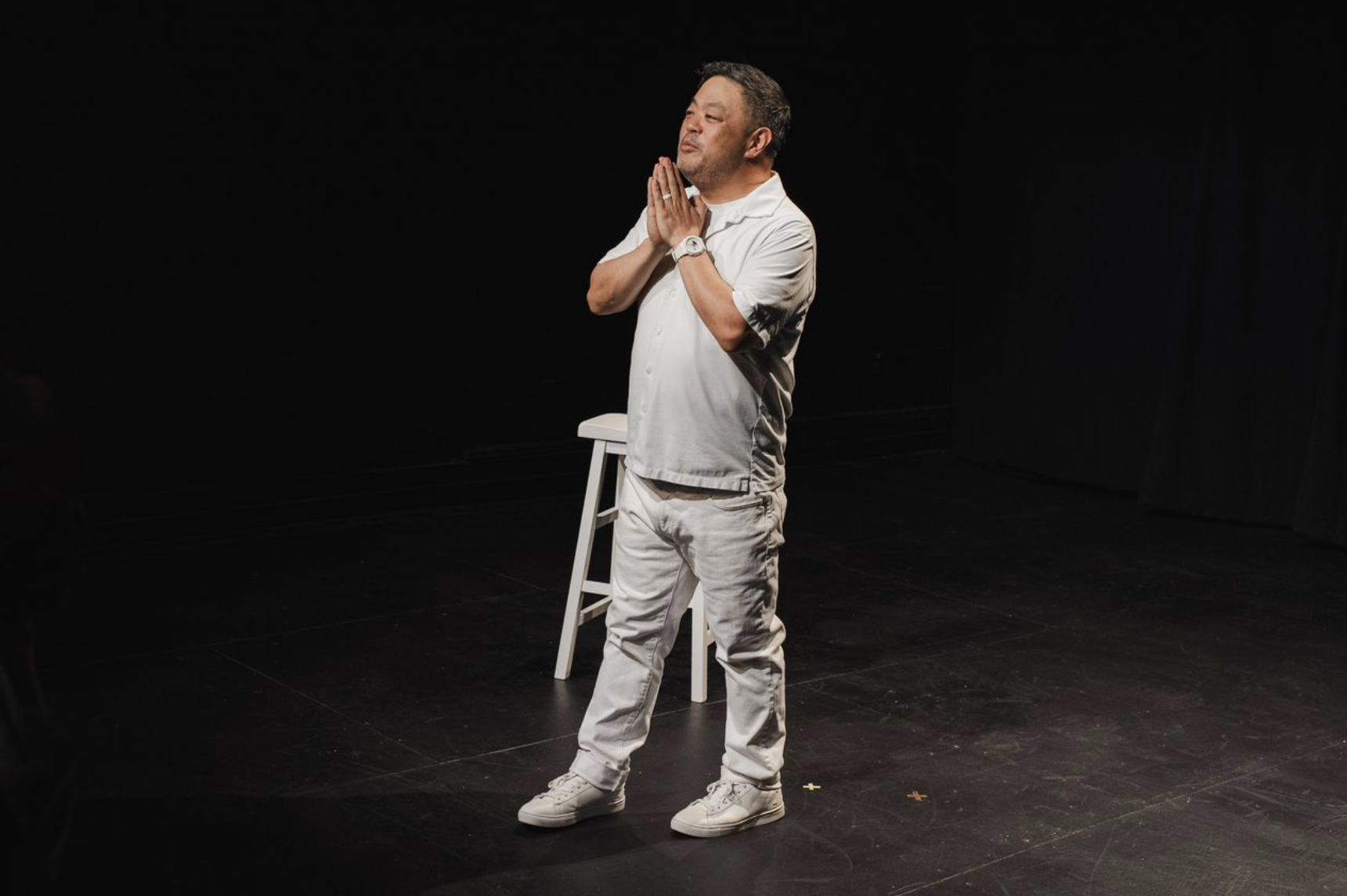
Chris Grace’s marvelous Sardines (a comedy about death) accomplishes something that sounds almost impossible on paper: it transforms grief into communion, mortality into mischief, and loss into an occasion for gratitude. Performed on a nearly bare stage with little more than an imaginary slide projector and the force of Grace’s singular presence, the show arrives with the modesty of a casual conversation and departs having quietly rearranged one’s emotional landscape. It is among the most moving and accomplished solo performances in recent memory, a work of uncommon wisdom disguised as an evening of gentle amusement.
The title derives from the children’s game in which one player hides and the others gradually squeeze themselves into the same concealed space until a lone seeker remains, wandering the house wondering where everyone has gone. For Grace, who lost his sister, brother, mother, father, and longtime partner before reaching old age himself, the metaphor lands with devastating precision. Yet what is remarkable is not the sorrow embedded within the image but the generosity with which Grace explores it. Rather than constructing a monument to suffering, he offers a meditation on how the dead migrate from our daily lives into our interior worlds, becoming permanent residents of memory.
Grace belongs to the lineage of great autobiographical monologists who understand that storytelling is not merely recollection but transformation. Like the finest practitioners of the form, he draws upon formidable acting skills while never appearing to act at all. Dressed entirely in white—the traditional color of mourning in Chinese culture—he stands alone on a bare stage and invites us to imagine a slideshow whose images never materialize. The conceit is exquisitely simple. With an invisible clicker and an actor’s gift for specificity, he conjures photographs more vivid than any projection could provide. A family portrait becomes an entire history. An absent father becomes a wound. A remembered voice becomes a resurrection.
What distinguishes Sardines is Grace’s astonishing tonal dexterity. He can guide an audience into the depths of heartbreak and then, at precisely the right moment, rescue them with laughter that feels neither evasive nor manipulative but profoundly humane. Stories about panic attacks, American healthcare, acting out Donna Summer’s “MacArthur Park,” and an unexpectedly transcendent audience singalong to Rihanna’s “Please Don’t Stop the Music” emerge not as comic detours but as evidence of life’s stubborn refusal to become solemn for very long. Grace understands that humor and grief are not opposing forces; they are often roommates occupying the same cramped hiding place.
The evening reaches extraordinary emotional heights when Grace recounts the sudden death of his partner following what seemed to be an ordinary bout of the flu. The description is unsparing yet never sensationalized. He recreates the frantic attempts at resuscitation, the arrival of emergency responders, and the bewildering aftermath with a restraint that makes the account all the more shattering. Equally affecting are his reflections on his father’s enduring homophobia and the complicated tenderness that survived it. Grace refuses easy reconciliations, preferring instead the messier truths that characterize actual families. The result is not confession but illumination.
What makes the production so remarkable is its confidence in simplicity. Directed with elegant precision by Eric Michaud, Grace’s husband and creative collaborator, the show relies on no technological wizardry, no elaborate design, no theatrical grandstanding. The sole significant audio cue arrives late in the evening and lands with breathtaking force. Throughout, Grace trusts language, memory, and imagination to do the heavy lifting. That trust is rewarded. The audience leans forward, supplying the images, the faces, and the emotions that the production merely suggests. Few contemporary theater artists understand so completely how little is required to create something immense.
By the end, Sardines reveals itself to be organized around a deceptively simple question: Can we take joy in something if, as with life itself, we know how it ends? Grace never pretends to have discovered a definitive answer. Instead, he circles back to a poem his mother wrote shortly before her death, one that begins, “People are the same / we all want the same thing,” and ends with the hopeful assertion that “As long as people risk their lives for human rights / we still have hope / we still have time.” That hard-earned optimism becomes the show's quiet thesis. The title's childhood game ceases to be merely a metaphor for death and becomes one for human connection itself. No matter how alone loss may leave us feeling, Grace suggests, we are not alone in that feeling. We are all, sooner or later, the last sardine left searching the house for the others. The achievement of this extraordinary evening is to remind us that the search itself—and the love that inspired it—is what gives life its meaning.
Click HERE for tickets.
Review by Tony Marinelli.
Published by Theatre Beyond Broadway on June 1, 2026. All rights reserved.
