THE LADDER
Written by Isaac Byrne, Directed by Haley Rice
Presented by Haley Rice in association with Messy Stars Productions
IRT Theater | 154 Christopher St, New York, NY 10014
January 31 to February 15, 2026
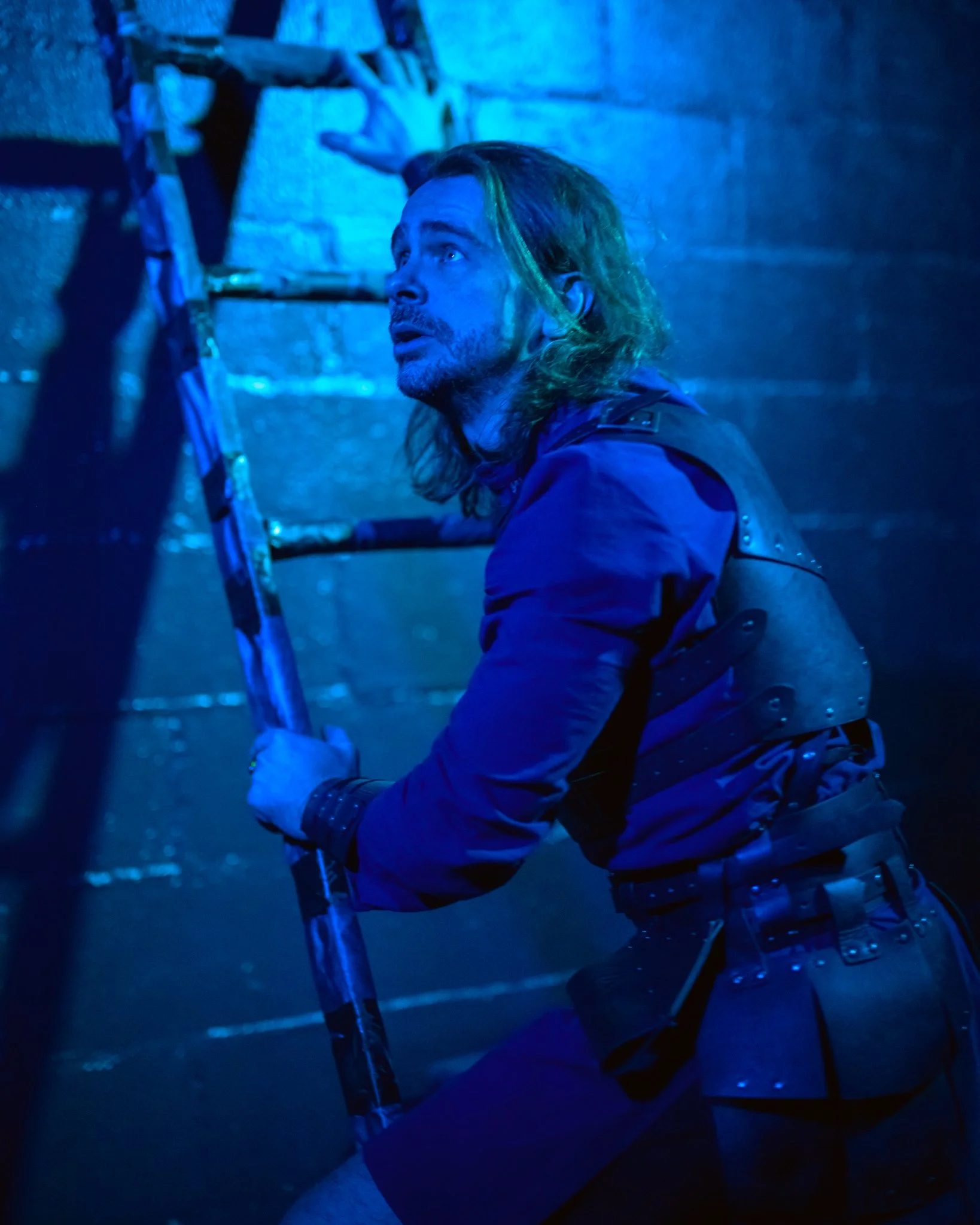


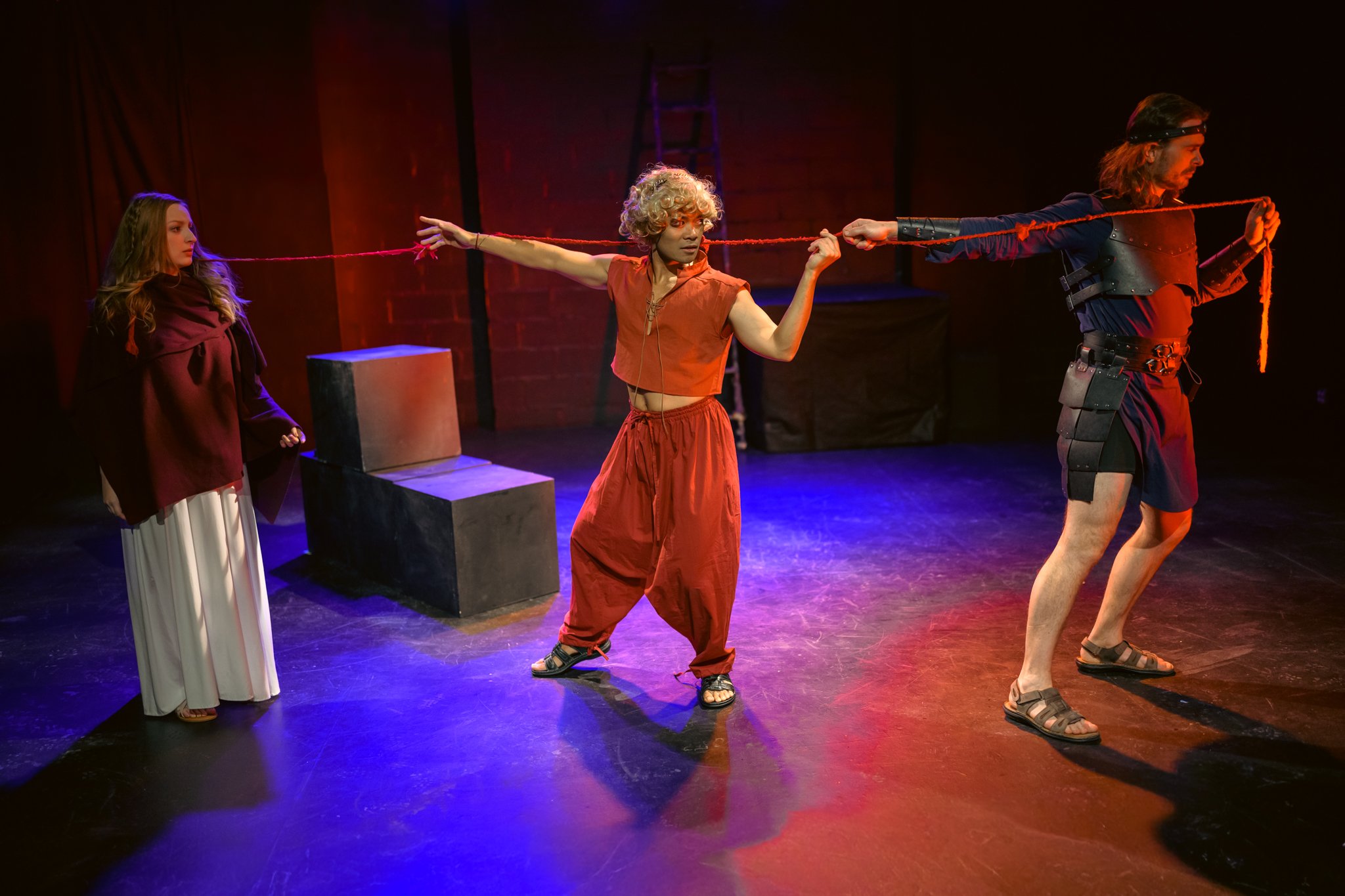

Photo Credit: Mikhail Lipyanskiy
“The monster in this story is very real,” Theseus announces within the first five minutes of The Ladder, and it is a wonderfully rude way to begin. It’s not a tease, it’s a mission statement. He’s naming the monster before anyone else can name it. In staging playwright Isaac Byrne’s queer retelling of Theseus and the Minotaur, Haley Rice and Messy Stars Productions are not interested in polite myth-making. They’re interested in the part where the hero starts to look like a man reciting self-help affirmations in the mirror, except the affirmations are for eeevil, and he’s clearly been practicing.
When a character tips their hand early, naming the monster for us, we’re usually asked to do two kinds of work. One is voluntary: we suspend disbelief as the other characters fail to clock what we clock instantly, because we’ve been let in on it first. The other is involuntary: we start empathizing with a person who is clearly dangerous, because their motivations are recognizably human, their charm is functional, and their self-justifications sound uncomfortably familiar. The Ladder dodges the laziest version of that first bargain. Here, more than one character does clock that Theseus is untrustworthy, and the tension shifts to why they go along anyway, out of need, out of calculation, or out of a love that refuses to be sensible. In 2026, under the regime of a truly disgusting snake oil salesman who somehow got elected twice, that involuntary empathy can feel less like entertainment and more like an occupational hazard.
Byrne writes like someone who knows laughter is leverage. He gets you to give it freely, then makes you feel the bill in your teeth. The play is at times hilarious, at times horrific, and consistently soulful, even as it turns the blade. You think you’re settling in for a myth you know, then the script starts shifting the floor under your feet. The maze is not just a setting, it’s a moral engine, and the blood-red ladder at the center of the design becomes a visual thesis: ambition as an object you climb, worship, and eventually bleed on.
It’s tempting to reduce the Minotaur to a familiar allegory, the monster inside all of us, the shadow self, the hunger, the shame. The Ladder goes further. Here, the labyrinth feels like an invitation, a place where Theseus can finally stop performing goodness and start performing greatness. That distinction matters. The play’s scariest idea is not that evil exists. It’s that evil can feel like relief, especially to a man who cannot tolerate being ordinary.
I’ll avoid spoilers because The Ladder has a mean little streak of surprise, and it earns that pleasure. The final scene makes trust feel like a liability, and the myth’s famous thread returns full circle with damning consequences. Let it be enough to say that we watch Theseus climb, downshift, and side-step along his ladder of vaulting ambition, and we also watch the people he steps on, the people he leaves behind, and those left living with the legend he manufactures.
The Ladder is less interested in a monster than in who gets to name one. In the tradition of modern retellings that interrogate heroism rather than celebrate it, the play is about the machinery that turns that naming into legend. It treats myth as a contested narrative, built from bravado, fear, and selective memory, where omission and manipulation do as much work as any sword. That frame also sharpens what gets minimized in the Theseus story, especially Ariadne’s thread, the unseen work that makes heroism possible. It also clarifies what gets rewarded: the predatory masculinity that calls swagger and violence “heroism,” and erases women’s labor by design.
The play draws heavily on the lesser-known story of Theseus and his best friend with benefits, Pirithous, and their disastrous trip to the underworld to abduct Persephone, yes, that Persephone. Fight and intimacy choreographer Leana Gardella delivers a standout sequence in the pair’s first meeting, a complex and delicious blend of clowning, combat, and sexual domination that is riotously funny and quietly revealing. It’s a scene that understands how power games read as flirting, and how quickly flirting can become a blueprint for cruelty and control.
Then the play turns the screw. Byrne reaches into ancient material with mischievous intelligence, including a grotesque comic image associated with Theseus and Heracles in the underworld, and the production delivers it with maximum irony to revolting effect. The body-horror moment that follows is not just gruesome, it’s devastating, because Pirithous doesn’t deserve it, and because he still loves Theseus anyway. The real gut punch is that love doesn’t save him; it condemns him.
Rice’s direction is disciplined, athletic, and thrillingly assured. She directs with a kind of muscular intelligence, shaping tone like a sculptor, and trusting the audience to follow her into uglier terrain without losing the thread. Comedy is not a garnish here, it’s the setup. She mines every last laugh, then snaps us into terror, not as a gotcha but as a moral pivot. On a shoestring budget, she composes stage pictures that are boldly stripped-down yet richly textured, and the physical storytelling stays legible even when a scene slides from flirtation and clowning into punishment, and then, almost without warning, into heartbreaking tragedy.
The production’s design does serious narrative work. David Aab’s lighting makes full use of the IRT setup, creating moody washes, ominous silhouettes, and strategic darkness that hands the reins to sound at exactly the right moments. That darkness is not a cheat, it’s a choice, and it pays off. Josh Koback’s multi-channel sound design is immersive in a way that gets under your skin. Sound travels, it reverberates through bodies, it turns the audience into part of the maze. The Minotaur’s presence becomes something you feel before you see, and the labyrinth starts to sound like self-loathing, that interior noise that grinds on long after the lights go out.
Caycee Black’s costumes, anchored by faux black leather armor, elegantly bridge Greek myth and modern kink-coded iconography, with a sly wink toward superhero aesthetics. Her Persephone costume, in particular, is storytelling you can wear, a design that telegraphs elegance, ferocity, majesty, and menace before a line is spoken.
The performances match the production’s appetite. James Jelkin is terrific as Theseus, a dangerous dumbass with a gifted mouth and a bottomless need to be seen. Jelkin plays him as a man who believes his own legend because the alternative is unbearable. He is charming, loquacious, and transparently terrified of being nobody, which is exactly why he keeps choosing to be dangerous instead. In that context, his self-ascribed nickname “Big T” reads like a cluster of meanings, testosterone, terror, tyrant, “truth,” and a certain contemporary con man’s loathsome brand of swagger.
Appropriately, the play’s gods and the people they break are where the evening hits its highest voltage. Rebekah Rawhouser’s Persephone, Queen of the Dead and goddess of spring, dominates the stage with radiant authority. She radiates divine power, and she takes palpable pleasure in profane games, but the real thrill in her performance is the precision with which she exposes weakness. She is not just kinky, she is surgical, cutting straight to weakness with no interest in mercy. When she delivers the play’s central line, it comes down like divine judgment: “Scary, isn’t it? To be what you are and not what you say.” In this play, the truth isn’t purifying. It’s a scalpel, cold, precise, and unsparing.
Justin Senense, double-cast as Pirithous and Dionysus, is dazzling. As Pirithous, he plays the bossy bottom clown with an emotional honesty that keeps the joke from turning hollow or wearisome. As Dionysus, he becomes unsettlingly serene, the calm in the eye of the storm. When the play returns to Pirithous in the underworld, Senense lets tenderness and longing burn through the punishment, making his suffering sharper, not softer.
Lucy Turner’s Ariadne is a quiet triumph. Her Bacchic transformation under Dionysus’s influence is played with specificity and release, drunk on the healing power of revenge, and it’s deeply satisfying to watch the character stop shrinking herself to fit someone else’s hero narrative. Ken Orman’s King Aegeus gets a heartbreaking moment of recognition, the black sail, the sudden understanding, the kind of tragedy that arrives not as shock but as inevitability.
What makes The Ladder’s queerness feel essential, rather than decorative, is that it changes the moral math of the myth. It shifts the story away from conquest and toward complicity: who gets named hero, who gets labeled monster, and who gets left holding the consequences. It also insists on the bodies behind the legend, especially the ones that mythology tends to treat as collateral.
The Ladder is funny, then punishing, then weirdly tender, and it refuses to let “monster” remain a convenient metaphor. It becomes a role someone rehearses, refines, and eventually gets rewarded for. Go for the myth, stay for the craft, and leave with the sour realization that the worst villains are often the ones who name the monster first, and still dare you to applaud.
Click HERE for tickets.
Review by Ariel Estrada.
Published by Theatre Beyond Broadway on February 4th, 2026. All rights reserved.
